Sustaira VS Sweep
For organizations evaluating enterprise sustainability software, the difference between platforms is not only about calculating emissions. The real question is whether the solution can support long-term sustainability transformation across business units, data ecosystems, suppliers, reporting requirements, and evolving regulations.
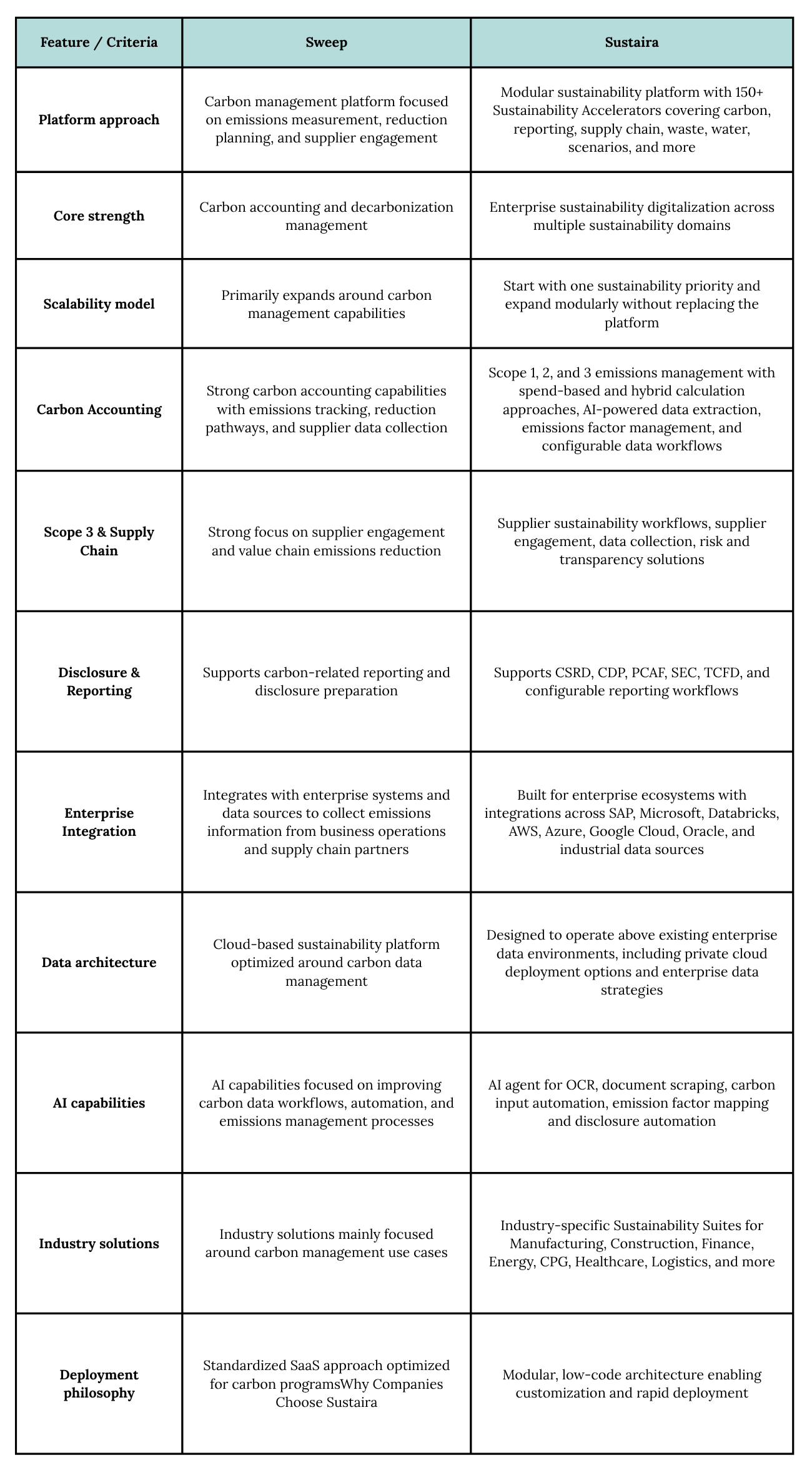
This guide provides a direct operational and technical comparison between Sustaira and Sweep. While both platforms support carbon management and Scope 1, 2, and 3 emissions tracking, they are built around different philosophies: Sweep focuses primarily on carbon management and decarbonization programs, while Sustaira provides a modular sustainability platform designed to scale across multiple sustainability domains.
Head-to-Head Comparison
Why Enterprises Looking Beyond Carbon Choose Sustaira
When sustainability leaders evaluate platforms for long-term transformation, the decision often comes down to whether they need a dedicated carbon solution or a broader sustainability foundation.
Sustaira helps organizations move from isolated sustainability initiatives toward an integrated sustainability operating model through three key advantages.
1. Beyond Carbon: A Sustainability Platform That Evolves With Business Needs
Carbon accounting is often the starting point for sustainability transformation, but enterprise sustainability requirements continue to expand.
Organizations are increasingly expected to manage supplier transparency, sustainability reporting, waste reduction, climate scenarios, operational improvements, and additional sustainability priorities alongside emissions reduction.
Sustaira enables companies to start where the need is greatest, such as Carbon Accounting or CSRD reporting, and progressively expand into additional sustainability domains through a modular building-block approach.
Instead of creating a landscape of disconnected sustainability tools, organizations can develop a scalable platform that grows with their sustainability maturity.
2. Enterprise Data Strategy and Flexibility
Sustainability data is becoming part of the wider enterprise data ecosystem. To create reliable insights, companies need solutions that connect sustainability information with ERP systems, procurement platforms, operational technology, and existing data environments.
Sustaira is designed around enterprise flexibility. Through its low-code architecture, integration capabilities, and private cloud deployment options, organizations can align sustainability workflows with their existing technology landscape.
This approach helps reduce data duplication, improve governance, and create stronger collaboration between sustainability teams and IT departments.
3. From Software Implementation to Sustainability Transformation
Technology adoption is only one part of successful sustainability transformation. Organizations also need the right processes, ownership models, and internal capabilities to turn sustainability data into action.
Through the Sustaira Sustainability Digitalization Program, organizations receive a structured approach to aligning technology, data, people, and processes.
Using the 3S Framework (Start, Structure, Scale) and the 5P Digitalization Pillars (Portfolio, People, Process, Platform, Promotion), Sustaira helps companies establish a scalable sustainability operating model.
This enables sustainability information to become actionable across procurement, operations, finance, compliance, and business units rather than remaining a reporting exercise.
Sweep is a strong choice for organizations looking to build a dedicated carbon management and decarbonization program, particularly around emissions tracking, Scope 3 engagement, and climate action initiatives.
Sustaira is designed for organizations that want to go beyond carbon accounting and create a scalable sustainability operating model that connects data, technology, processes, and multiple sustainability priorities.
For enterprises facing increasing sustainability requirements, the strategic question is not only:
"How do we measure our emissions?"
but also:
"How do we build the infrastructure to continuously improve sustainability performance across the organization?"