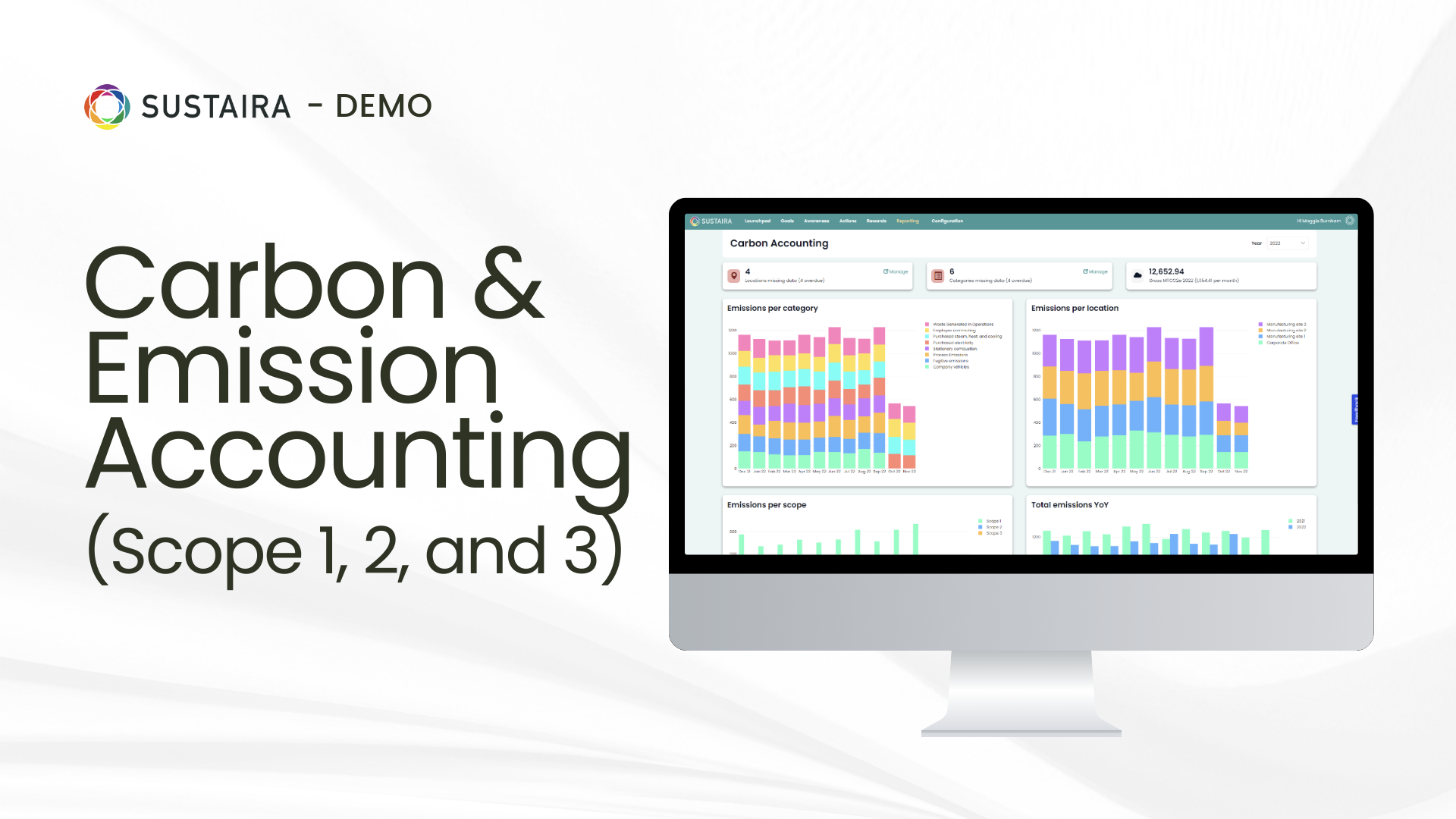
Top 10 Carbon Accounting Solutions in 2026: How Modular, Industry-Specific Platforms Help Organizations Reduce Costs and Scale Impact
In 2026, the cost of sustainability is a boardroom-level priority. For many organizations, carbon accounting has become a source of "hidden" costs: expensive manual data entry, fragmented spreadsheets, and the high price of generic software that fails to meet industry-specific regulatory requirements such as the CSRD. These "one-size-fits-none" platforms often slow down progress, turning a mission-critical initiative into a financial and operational burden.
To deliver a true return on investment, sustainability leaders must move beyond simple measurement. The goal is now to reduce the costs of sustainability outcomes by using modular, AI-powered solutions that drive measurable impact and mitigate regulatory risk through actionable insights.
To help you navigate this landscape, here are the top 10 carbon accounting solutions empowering sustainability leaders to reduce costs and accelerate impact in 2026.
1. Sustaira: Modular, AI-Powered Industry-Specific Suites and Solutions
Sustaira leads the market with a mission to accelerate sustainability impact by empowering leaders with modular, AI-powered solutions. Rather than offering a rigid, generic platform, Sustaira empowers organizations by giving them a choice: start with a single Carbon Accounting solution, lower cost, focused, and fully integrated with existing systems, or deploy a full Industry-Specific Suite that goes beyond carbon accounting to address complex, sector-specific sustainability needs. This flexible approach helps organizations avoid overspending on rigid, one-size-fits-none platforms while giving the option to expand over time with additional modules.
The platform provides a powerful Carbon Accounting Solution, compliant with the GHG Protocol. Organizations can then expand using other modular, low-code solutions or choose pre-configured industry-specific suites that provide end-to-end functionality for complex sectors such as industrial manufacturing, logistics, construction, and financial services.
A key differentiator is the Private Cloud deployment option, which allows highly regulated industries to fully tailor the platform without compromising compliance. Organizations retain full control over their data, enabling their IT teams to manage storage, security, and integrations, something no other carbon accounting vendor currently provides.
Designed with efficiency and cost-effectiveness in mind, Sustaira helps organizations achieve tangible benefits:
Enhanced productivity of sustainability teams by automating data collection and reporting
Cost reduction of sustainability outcomes and innovation through targeted, modular solutions
Risk mitigation with actionable insights that simplify compliance and decarbonization planning
Its modular design allows organizations to scale and expand over time, avoid unnecessary costs while achieving end-to-end sustainability management tailored to their industry. This approach also makes it ideal for organizations already using existing platforms, as it can extend capabilities without requiring a full platform replacement, enabling teams to integrate and add new modules as needs evolve.
2. Workiva
Founded in 2008, Workiva began as a cloud platform to simplify business reporting, replacing manual spreadsheets with audit-ready, collaborative workflows. It consolidates ESG, finance, risk, and compliance data for enterprises focused on reporting and regulatory compliance.
Workiva Carbon, launched in 2024, adds carbon accounting and decarbonization capabilities, enabling Scope 1‑3 emissions measurement, supplier engagement, reduction tracking, and audit-ready reports aligned with CSRD, TCFD, and CDP.
However, customizing the platform for niche industry workflows often requires significant manual effort, which can increase long-term operational costs.
3. SAP Sustainability Control Tower
SAP Sustainability Control Tower integrates ESG and carbon reporting into enterprise-scale operations, leveraging ERP, CRM, and other systems. It consolidates ESG metrics across business units, generates standardized dashboards, and aligns reporting with global regulatory frameworks.
While it offers enterprise-scale capabilities, the complexity of implementation often demands significant IT resources, making it less agile than modular alternatives.
4. Sweep

Sweep specializes in automated carbon accounting and decarbonization, with a strong focus on Scope 3 emissions and supplier engagement. Its AI-driven workflows simplify data collection from suppliers and internal systems, enabling emissions tracking, reduction planning, and net-zero visualization.
While a good option for standard supply chains, organizations with highly specialized vertical operational needs may find their customization options limited, potentially resulting in data gaps and higher costs.
5. Persefoni
Persefoni provides compliance-focused carbon accounting, producing audit-ready reports aligned with GHG Protocol, SEC filings, and other regulatory frameworks. It standardizes carbon data management, helping finance teams generate defensible emissions disclosures. The platform supports scenario modeling and portfolio-level analysis for strategic decarbonization planning.
However, as its starting point is finance, it remains primarily a reporting tool, and organizations in other industries may struggle to implement the operational modules needed for industry-specific tracking and cost reduction.
6. Plan A
Plan A is a European platform emphasizing end-to-end decarbonization for mid-to-large enterprises. It automates data collection, detects anomalies, and guides companies toward actionable reduction strategies. TÜV-certified, it is recognized for structured and reliable ESG reporting. The platform includes carbon footprint tracking, reduction planning, and ESG dashboards, supporting regulatory compliance and sustainability goals.
Users value its guidance and data-driven insights, though recent organizational changes following the acquisition by Diginex may temporarily affect workflow flexibility and operational efficiency for complex use cases.
7. Watershed
Watershed focuses on Scope 3 emissions and supply chain engagement, helping organizations collect supplier data, monitor reductions, and drive collaborative decarbonization. It is particularly suited for tech and consumer brands with complex supply chains. The platform offers automated data collection, reporting, and supplier communication, enabling progress tracking toward net-zero goals.
While effective for corporate-level tracking, it may lack the site-level granularity required by heavy industrial sectors and can represent a significant investment for large-scale deployments.
8. Salesforce Net Zero Cloud
Salesforce Net Zero Cloud integrates ESG and carbon data into the CRM ecosystem, allowing organizations to track emissions, report progress, and align sustainability initiatives with business operations. The platform includes dashboards and analytics that link ESG metrics with business performance.
However, it may be less adaptable for detailed operational tracking in specialized industries and does not offer additional modules or multi-domain functionality, limiting its ability to support broader sustainability initiatives.
9. Sphera
Sphera specializes in environmental compliance, operational risk, and ESG analytics for industries such as energy, chemicals, and manufacturing. It helps companies monitor ESG risks, comply with regulations, and optimize operational sustainability. The platform provides analytics for emissions, compliance reporting, and operational performance, offering detailed risk insights.
Many users find they need to pair Sphera with more modern, modular AI tools to handle broader ESG innovation.
10. Schneider Electric
Schneider Electric delivers energy management and sustainability solutions across industrial and infrastructure sectors. Its platform helps organizations optimize energy use, reduce emissions, and manage environmental impact.
It provides analytics, reporting, and operational monitoring, supporting energy efficiency and sustainability targets. Users value its energy optimization expertise, though its applicability outside industrial sectors is limited, and the platform’s rigid systems can make customization for other industries challenging.
How Sustaira Extends and Complements Other Solutions
Sustaira combines operational depth, strategic oversight, and flexibility in a single platform. It enables granular tracking of site-level and supplier-level emissions, real-time KPI dashboards, and scenario modeling to guide decarbonization strategies, while Private Cloud storage ensures secure, compliant data management.
Its industry-specific suites and low-code customization allow rapid adaptation to unique workflows, and supplier engagement tools turn supply chain data into actionable insights.
With platform-integration and co-creation with partners, Sustaira scales alongside evolving Sustainability programs. These capabilities enable organizations to move beyond reporting and establish a comprehensive sustainability management system, connecting operations, strategy, and cross-team collaboration.
Conclusion: The Future of Carbon Accounting is Modular, Verticalized, and Partner-Ready
The most effective carbon accounting solutions combine accuracy, regulatory compliance, industry-specific functionality, and the ability to integrate with partners. Sustaira combines a modular, AI-powered platform, Private Cloud deployment, and industry-specific suites designed for highly regulated industries. Unlike other carbon accounting solutions, these capabilities allow organizations to start with carbon accounting and expand into additional sustainability areas, such as energy management and supply chain oversight, while scaling their programs over time.
The future of sustainability is customized, secure, and collaborative, but budgets are tight.
Sustaira enables organizations to achieve operational efficiency, reduce the cost of sustainability outcomes, and maximize impact without overspending, offering a cost-effective alternative to other high-priced platforms. While carbon accounting is essential, it represents just one piece of a broader sustainability strategy, and only modular, multi-domain platforms like Sustaira can deliver comprehensive, scalable, and financially sustainable solutions over the long term.
See Sustaira in action
Watch a demo of our Carbon Accounting solution or book a personalized walkthrough with our team of experts or read our 2026 Press Release to learn how your organization can accelerate sustainability impact and reduce costs.