Sustaira VS Workiva
For many enterprises, sustainability software is not evaluated in isolation. It is assessed within the broader context of financial reporting, risk management, and regulatory disclosure. In this environment, platforms are often selected not only for sustainability functionality, but for their ability to integrate with established enterprise reporting processes.
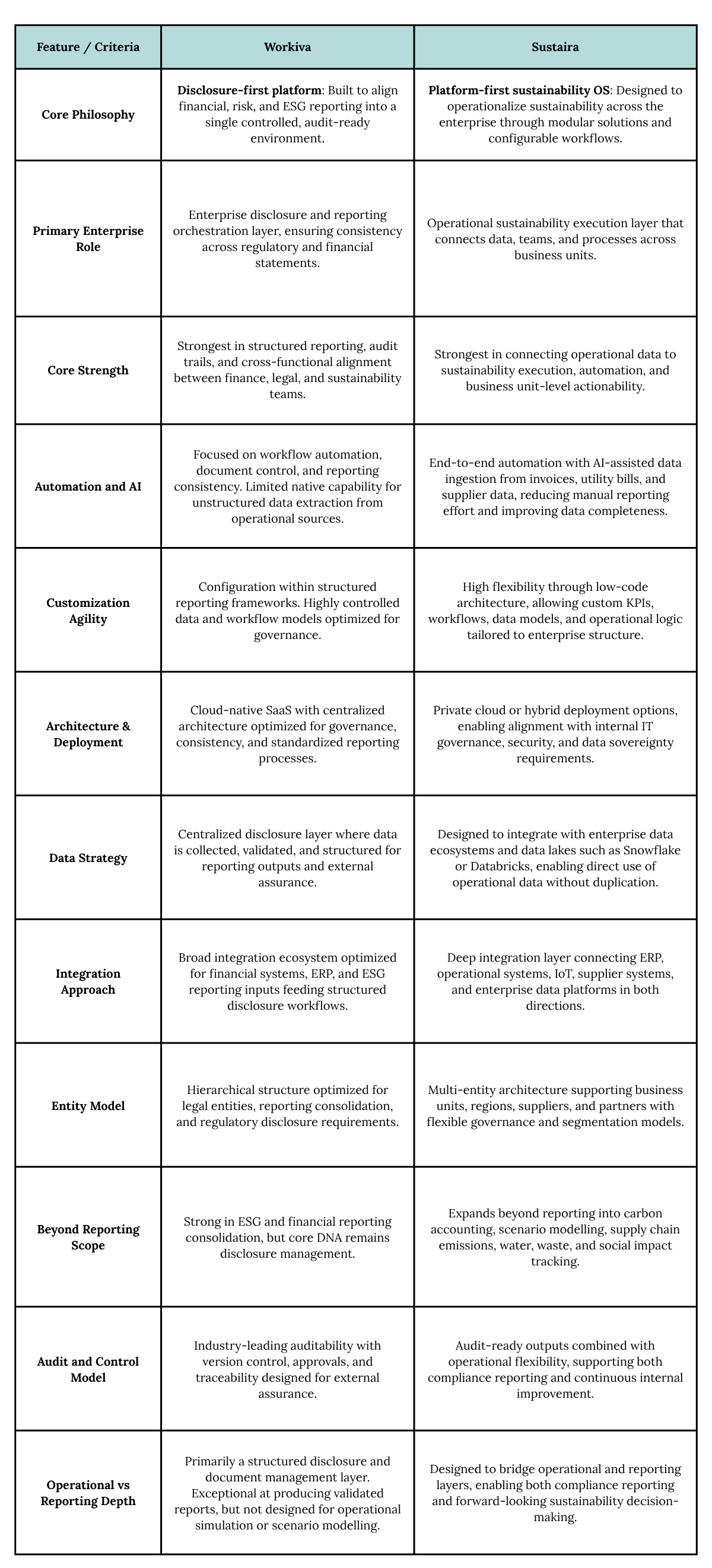
This comparison provides a direct, operational evaluation between Sustaira and Workiva. While both are used in ESG and sustainability contexts, they serve fundamentally different roles within the enterprise architecture. Workiva is positioned around disclosure governance and reporting integrity, while Sustaira is designed to operationalize sustainability across systems, teams, and business processes.
Head-to-Head Comparison
Why Companies Choose Sustaira
When organizations evaluate these two systems, the decision often comes down to how sustainability is positioned inside the enterprise: as a reporting obligation or as an operational capability embedded in day-to-day decision-making.
1. From Disclosure System to Operational Sustainability Layer
Workiva is widely recognized as a leading platform for enterprise disclosure management. Originating as a collaborative cloud solution for SEC reporting, it excels at ensuring that financial, risk, and ESG statements are consistent, traceable, and audit-ready across global standards.
Enterprise buyers typically choose Workiva for its ability to align accounting, legal, and sustainability teams within a single controlled reporting environment. This makes it highly effective for regulatory compliance and external assurance processes.
However, its architecture is fundamentally optimized for disclosure workflows rather than operational decision-making. Workiva functions primarily as a structured document and reporting layer rather than an analytical or simulation engine. It is not designed to model or simulate the operational impact of decarbonization initiatives, such as changes in manufacturing processes, logistics networks, or supplier behavior. As a result, it excels at producing validated reports on what has happened, but is less suited for exploring what could happen under different operational scenarios.
2. Enterprise Structure and Flexibility Requirements
Large enterprises rarely operate with a single uniform data structure. They consist of multiple business units, regions, suppliers, and joint ventures, each with different levels of data maturity and operational complexity.
Workiva is optimized for consolidated reporting hierarchies and standardized disclosure structures. This ensures consistency across global reporting cycles but can limit flexibility when organizations need to reflect operational diversity in their sustainability data models.
Sustaira, by contrast, is designed for multi-entity operational complexity. It allows different business units to operate with tailored KPIs, workflows, and data structures while maintaining centralized governance. This enables organizations to scale sustainability execution without forcing all units into a single rigid model.
3. Connecting IT, Data Architecture, and Sustainability Execution
Sustainability platforms increasingly sit at the intersection of enterprise IT architecture, data infrastructure, and business operations.
Workiva operates primarily as a controlled reporting environment where data is aggregated, validated, and structured for disclosure. This makes it highly effective for reporting integrity but limits its role in continuous operational data utilization.
Sustaira is designed to integrate directly into existing enterprise data ecosystems, including data lakes, ERP systems, and operational platforms. This allows sustainability teams to work with live or near-real-time data, bridging the gap between operational reality and sustainability reporting. Combined with its private cloud and hybrid deployment options, this ensures alignment with enterprise IT governance while supporting flexible, cross-functional use cases.