
Top 10 Sustainability Software in 2026 and beyond: What Enterprise Buyers Actually Care About
In 2026, enterprise sustainability has officially transitioned from a retrospective compliance checklist into a core operational discipline. Boardrooms are no longer willing to pay a "reporting tax", the combined financial drain of expensive manual data reconciliation, fragmented spreadsheets, and rigid, "one-size-fits-none" software that fails to adapt to sector-specific operational realities.
Because of this shift, selecting a sustainability platform is no longer just a choice for the sustainability department. It has become a corporate-level decision that must actively involve IT and align with strict enterprise policies on data protection, security architectures, and private cloud deployments. As sustainability data spreads across departments, these tools can no longer exist in an isolated silo. They must be flexible enough to be adopted and used by procurement for supply chain vetting, operations for asset optimization, finance for audit readiness, and legal for compliance.
As organizational needs constantly evolve, modern buyers want more than a static tool; they want to engage with a strategic system that supports them long term and scales dynamically alongside their expanding needs. Buyers care about seamless data integration across complex landscapes, agile change management to handle shifting international regulations (like CSRD, CBAM, and SEC mandates), and the ability to drive actionable decarbonization without exponentially adding headcount.
To help you navigate the landscape, here is the definitive breakdown of the top 10 sustainability software solutions empowering enterprise leaders in 2026, evaluated by what buyers actually care about.
1. Sustaira: Modular, AI-Powered Industry-Specific Suites and Solutions
Sustaira leads the market by transforming sustainability from a static reporting project into an adaptable, high-efficiency operational layer. Built with a mission to accelerate sustainability impact by empowering leaders with modular, AI-powered solutions, Sustaira directly answers the enterprise demand for financial and cross-departmental agility.
Instead of forcing companies into an expensive, rigid framework, Sustaira allows buyers to purchase individual solutionsor deploy an entire Industry-Specific Sustainability Suite (tailored for complex sectors like industrial manufacturing, logistics, construction, CPG, and financial services). This "Mix & Match" philosophy means organizations only activate the building blocks they need, keeping the Total Cost of Ownership (TCO) remarkably low while allowing teams like finance, operations, and procurement to adopt specialized modules over time.
A major differentiator for Sustaira in the enterprise landscape is its unique ability to extend and complement other software platforms. If an organization has already invested heavily in a legacy reporting platform, it does not need to undergo a disruptive, costly, and time-consuming rip-and-replace project. Sustaira can be deployed directly on top of or alongside existing tools to fill specific functional gaps, automate manual workflows, or introduce highly verticalized calculators without requiring a complete shift in the core IT stack. This allows organizations to preserve their existing platform investments while adding specific missing capabilities modularly.
What truly sets Sustaira apart is its Sustainability Digitalization Program. Rather than delivering software in isolation, Sustaira works side by side with organizations using a structured, programmatic model to synchronize technology, data architecture, and corporate culture . This framework relies on two core blueprints:
The 3S Framework (Start, Structure, Scale): A phased approach that moves organizations from initial data ingestion to structured governance, and finally to autonomous, enterprise-wide orchestration across all business functions.
The 5P Digitization Pillars (Portfolio, People, Process, Platform, Promotion): A structured model used to establish a cross-functional Center of Excellence, ensuring that data pipelines are trustworthy, workflows are agile, internal teams are fully trained, and sustainability is embedded into everyday business decisions.
What Enterprise Buyers Care About:
Deployment & Data Sovereignty: Sustaira is a pioneer in offering dedicated Private Cloud deployments (on AWS, Azure, Google Cloud, or Oracle). Highly regulated enterprises can completely customize their applications, data models, and workflows while retaining full control over data security and storage, perfectly satisfying corporate IT policies .
Integration Depth: Leverages an extensive library of pre-configured connectors and standard APIs to automatically ingest data directly from core enterprise systems like SAP, Salesforce, Microsoft, and specialized industrial OT platforms. Crucially, for organizations with advanced digital infrastructure, Sustaira offers the flexibility to sit directly above an enterprise data lake or centralized data warehouse, harmonizing disparate historical logs into a unified sustainability data model without requiring costly data duplication.
AI Value-Add: Features powerful embedded AI capabilities such as automated Document Scraping (using OCR/NLP to extract data from utility bills and invoices directly into carbon accounting modules) and intelligent activity mapping.
IT Collaboration: Leveraging Siemens' Mendix low-code architecture, allowing enterprise IT teams to tailor user roles, UI/UX, and local workflows up to 10x faster than traditional coding, while maintaining strict, centralized governance .
2. Watershed
Watershed acts as a highly prominent climate platform particularly popular among North American corporate brands, tech companies, and financial portfolios. It focuses heavily on greenhouse gas accounting rigor, measuring value-chain impact, and offering market-facing tools for high-quality carbon offset procurement.
What Enterprise Buyers Care About:
Enterprise buyers choose Watershed for its carbon calculation engine and strong marketplace visibility. However, buyers looking for a comprehensive ESG platform point out significant product boundaries.
Watershed is highly carbon-centric; organizations looking for deep functionality across non-climate metrics (such as detailed social indicators, complex health and safety tracking, or broader labor metrics) frequently find themselves having to buy secondary software tools to fill the gaps.
Furthermore, because Watershed operates on a standard public-cloud delivery model, highly regulated buyers facing data-sovereignty restrictions cannot isolate the application within their own dedicated IT boundaries.
Finally, its supplier engagement module focuses heavily on emissions questionnaires rather than end-to-end supply chain operational due diligence, creating a technical gap for companies managing complex, physical asset networks.
3. Workiva
Workiva remains an enterprise powerhouse for organizations where financial, risk, and ESG disclosure alignment is the primary mandate. Originating as a collaborative cloud platform for SEC reporting, Workiva’s data linkage structures ensure that corporate statements are audit-ready and aligned with global standards.
What Enterprise Buyers Care About:
Enterprise buyers choose Workiva for its unparalleled strength in cross-team collaboration between accounting, legal, and sustainability functions. Its standard disclosure management structures are highly reliable for strict compliance assurance.
However, from an operational perspective, Workiva functions primarily as a sophisticated document aggregation layer rather than an active calculation or simulation engine. The platform has a steep learning curve for non-financial or non-technical teams, and it lacks robust, native scenario-modeling tools. This means that while it is exceptional at formatting a final report, it cannot easily help an engineering or operations team simulate the forward-looking financial or operational impact of a physical decarbonization project on the factory floor.
4. Salesforce Net Zero Cloud
Salesforce embeds environmental and carbon tracking natively into its widespread CRM ecosystem. By leveraging the data landscape of the broader Salesforce platform, Net Zero Cloud allows commercial teams, procurement managers, and suppliers to track sustainability metrics within a familiar interface.
What Enterprise Buyers Care About:
For companies already running a unified Salesforce instance, this platform offers rapid implementation and instant executive dashboard visibility.
The primary drawback encountered by buyers is the "Salesforce dependency." If an enterprise has business units, acquired subsidiaries, or supply chain partners that do not operate inside the Salesforce ecosystem, pulling data out of those external systems and mapping it into Net Zero Cloud introduces high API development costs.
Additionally, the platform is largely designed as a recording log and presentation dashboard; it lacks decision-grade, deep analytics or native low-code toolkits that allow local warehouse or factory managers to build custom, field-level operational workflows.
5. Sweep
Sweep has earned substantial market share among international brands facing dense Scope 3 value-chain complexities. The platform specializes in mapping emissions across large networks of business units, subsidiaries, and third-party vendors, visualizing progress through a clean, intuitive dashboard.
What Enterprise Buyers Care About:
Sweep’s data collection workflows are exceptionally efficient at automating supplier questionnaires and aggregating vendor feedback. However, enterprise buyers note that Sweep focuses heavily on transparency and organizational alignment rather than deep compliance-ready automation.
For companies facing the granular, item-level verification demands of frameworks like the CSRD or specialized local environmental audits, Sweep’s out-of-the-box data structures can require extensive manual data validation. It is designed to drive internal ownership and carbon strategy, meaning organizations prioritizing highly technical, audit-ready, calculation-level defensibility often find its compliance depth thin.
6. SAP Sustainability Control Tower
SAP integrates sustainability metrics directly into the core transactional foundation of global commerce. By pulling data natively from ERP, material management, and supply chain ledgers, the Control Tower treats sustainability data with the same operational rigor as financial accounting.
What Enterprise Buyers Care About:
Buyers choose SAP when they require massive enterprise-scale consistency and look to build an institutional system of record across a highly international business landscape.
The main operational hurdle is that the Sustainability Control Tower is heavily dependent on a highly mature, clean SAP ERP architecture. If an enterprise has fragmented ERP legacy instances, handles data across non-SAP acquisitions, or relies on multi-cloud configurations, the implementation becomes a massive, multi-year IT consulting project. It lacks the agility needed to quickly spin up standalone sustainability pilots or connect easily with external, non-standard supplier networks.
7. IBM Envizi
Envizi brings IBM’s historical strength in data analytics, technical infrastructure, and building management to the sustainability domain. It acts as a comprehensive software engine designed to handle massive volumes of unstructured operational data, utility bills, and facility-level telemetry.
What Enterprise Buyers Care About:
Buyers with vast real estate portfolios, extensive data centers, or multi-facility physical operations choose Envizi for its robust data cleansing, automated auditing, and utility invoice ingestion engines.
The challenge for enterprise buyers is that Envizi’s user interface and operational workflows are heavily skewed toward facility managers, data engineers, and IT specialists. It behaves like a complex backend database tool. As a result, non-technical sustainability teams, corporate communication leads, and cross-departmental business users frequently find the platform counter-intuitive, leading to slow organizational adoption and high internal training costs.
8. Sphera
Sphera is a long-standing leader in environmental health and safety (EHS), operational risk management, and product stewardship. It relies on decades of deep domain expertise and proprietary Lifecycle Assessment (LCA) databases, making it an essential platform for heavy manufacturing, chemical, and extraction industries.
What Enterprise Buyers Care About
Buyers facing strict product chemical compliance, material safety data requirements, or intensive regulatory risk choose Sphera for its immense technical depth and defensibility. However, corporate buyers looking for a modern corporate sustainability tool voice strong concerns regarding its technological legacy.
The platform is built on an older, fragmented system architecture resulting from various corporate acquisitions. This makes its user experience feel legacy-bound and difficult to integrate with modern cloud-native systems or real-time AI tools.
It is an excellent backend risk calculator, but it struggles to serve as a collaborative, forward-looking platform for corporate-wide sustainability innovation.
9. Osapiens
Osapiens has established itself as an essential compliance layer for international supply chain visibility, particularly in response to strict European directives such as the Corporate Sustainability Due Diligence Directive (CSDDD), EUDR, and CBAM. It focuses intensely on operations, logistics, and tracking cross-border material movements.
What Enterprise Buyers Care About:
Buyers choose Osapiens when operations-level compliance and tracking physical shipments through a complex supplier network is the immediate priority. The primary limitation is its highly narrow, hyper-localized compliance focus.
While it is an exceptional specialized toolkit for European trade regulations and border adjustments, it lacks the broad strategic capabilities required to handle corporate-wide ESG target-setting, carbon footprint scenario modeling, or holistic corporate sustainability reporting outside of supply chain risk containment.
10. Persefoni
Persefoni specializes in producing investor-grade, compliance-focused carbon data management systems, specifically aligned with the Greenhouse Gas Protocol and financial reporting standards. It is tailored for CFOs, private equity firms, and commercial banks that treat carbon as a critical financial asset or risk vector.
What Enterprise Buyers Care About:
Persefoni’s mathematical frameworks provide a highly robust, auditable data trail that satisfies accounting firms and financial regulators. However, buyers find that the platform’s geographical and contextual focus is highly tailored to North American regulatory expectations and finance-first metrics.
For European operations trying to map detailed, multi-layered requirements like full CSRD/ESRS implementation, Persefoni’s native framework alignment can feel thin.
Furthermore, because it is built to function like a financial ledger, it does not include operational, field-level modules for tracking non-financial variables like localized circular economy metrics, waste streams, or biodiversity impacts.
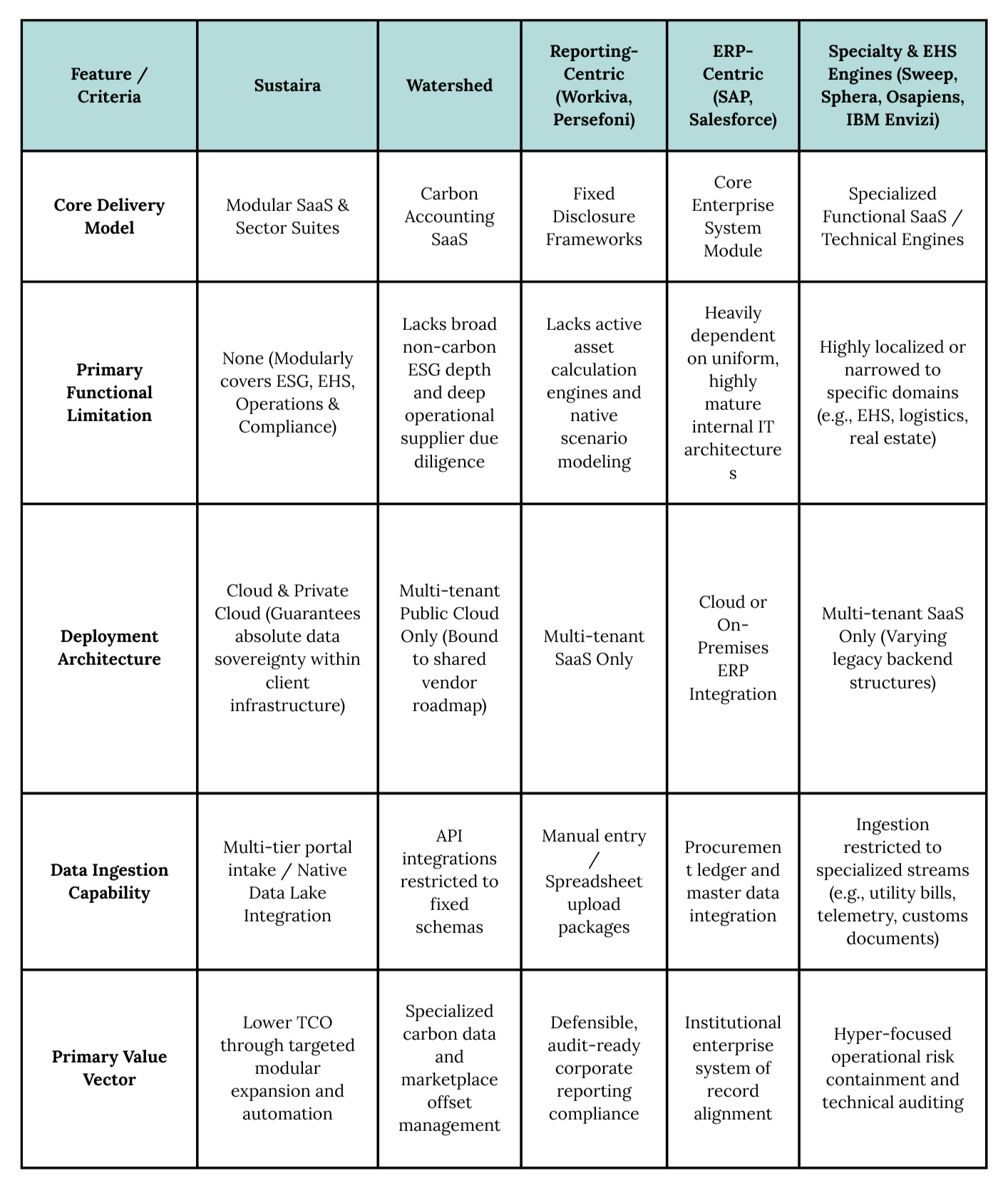
Evaluation Checklist: How the Top Solutions Stack Up
When buyers evaluate platforms, they balance priorities across three core lenses: Functional, Technical, and Organizational.
Choosing the Right Path Forward
Enterprise buyers in 2026 are avoiding software that imposes fixed, corporate workflows that run counter to actual operational realities. The choice of sustainability platform ultimately depends on your organization's digital maturity and strategic priorities.
If your current bottleneck is strictly limited to top-level corporate reporting and legal compliance, platforms like Workiva or Persefoni offer excellent, defensible starting points. If you are seeking a massive, standardized system of record embedded deep within your financial transactions, the SAP path provides institutional consistency.
However, if your organization is seeking to move beyond passive reporting into proactive decarbonization and operational cost optimization, a modular, verticalized platform is required. By combining a low-code architecture, full private cloud data sovereignty to meet rigorous IT policies, and a structured, hands-on rollout program like The Sustainability Digitalization Program, platforms like Sustaira enable companies to fill existing data gaps, automate tedious manual processes, and add new sustainability modules seamlessly as their programs expand over time.
