
How to automate Scope 3 Reporting Across Complex Sub-Contractor Networks

For construction and real estate development executives, the era of treating sustainability as a secondary corporate social responsibility initiative is over. Driven by sweeping global regulatory frameworks, such as CSRD in E urope and evolving climate disclosure rules in North America, carbon performance has rapidly transformed into a core operational metric and a major driver of enterprise value.
Yet, as sustainability directors work to map their organizational footprints, they inevitably collide with the industry’s most formidable hurdle: Scope 3 value chain emissions.
In the construction sector, Scope 3 emissions regularly account for 80% to 90% of an organization's total carbon impact. Because construction relies on highly fragmented, multi-tiered networks of sub-contractors, specialized trades, and material suppliers, gathering reliable data is notoriously difficult. Historically, the industry has relied on spend-based proxies and retroactively compiled spreadsheets to satisfy carbon accounting requirements.
Today, that approach introduces unacceptable compliance risks, greenwashing exposure, and operational inefficiencies.
Moving beyond administrative guesswork requires replacing manual workflows with an automated, site-level data ecosystem. This guide breaks down the strategic blueprint for automating Scope 3 data collection across complex sub-contractor networks.
The Root of the Problem: Why Construction Scope 3 Data Fails
Traditional sustainability software typically approaches carbon accounting from a corporate ledger perspective. While standard platforms process utility bills or corporate travel data effectively, they struggle to capture the operational realities of an active, multi-entity job site.
Construction projects are distinct, temporary ecosystems with severe operational barriers:
Sub-Contractor Fragmentation: A single commercial development can employ dozens of sub-contractors. These vendors range from multinational engineering firms to localized trade sub-contractors, many of whom lack dedicated sustainability personnel or standardized reporting capabilities.
ERP and Project Management Gaps: Core operational systems, such as Procore, Autodesk Construction Cloud, or Oracle Primavera, are optimized for project timelines, safety metrics, and financial budgets. They were not engineered to govern granular environmental data models, manage emissions factors, or compile auditable climate metrics.
The "Spreadsheet Tax": Chasing down ad-hoc fuel logs, waste diversion slips, and material delivery notes via email results in fragmented data silos. By the time this information is cleaned and formatted, the insights are purely historic, rendering proactive carbon management or optimization impossible.
Step 1: Automating Real-Time Data Harvesting at the Job Site
To automate Scope 3 reporting effectively, data aggregation must occur directly where the emissions take place: at the project site level. Rather than adding administrative burdens to site managers, organizations can utilize smart integration layers that transform existing operational touchpoints into automated carbon data pipelines.
On-Site Fuel Tracking and Telematics
Heavy machinery and mobile equipment represent a primary driver of project-site Scope 3 emissions. Instead of requiring sub-contractors to manually report monthly fuel delivery volumes, automated workflows ingest data directly from two main sources:
Digital Fuel Delivery Receipts: Connecting directly via API to the fuel procurement systems or distributors utilized by sub-contractors to capture exact gallon or liter consumption figures dynamically.
Telematics Integrations: Linking the platform to equipment telematics infrastructure (such as Geotab or manufacturer-specific IoT systems) to track exact runtime, idle time, and fuel burn rates by asset class across all trades on site.
Real-Time Waste Diversion Ingestion
Waste management and material disposal form another critical component of site-level metrics. Manual tracking involves chasing physical scale tickets from material recovery facilities or landfills weeks after a project phase finishes.
Automated data pipelines solve this by using Optical Character Recognition (OCR) and Natural Language Processing (NLP) to read digital haul tickets or invoices uploaded via a dedicated mobile interface. The system automatically extracts tonnages, material types, and diversion percentages, converting them into precise waste-category carbon equivalents in accordance with global accounting standards.
Step 2: Unifying the Supply Chain with the Super-Tenant Data Model
The core structural challenge of Scope 3 tracking is data isolation: General Contractors and developers cannot easily access or verify data held within a sub-contractor’s distinct operational systems.
To bridge this structural gap, the platform utilizes a multi-tier, multi-tenant architectural framework:
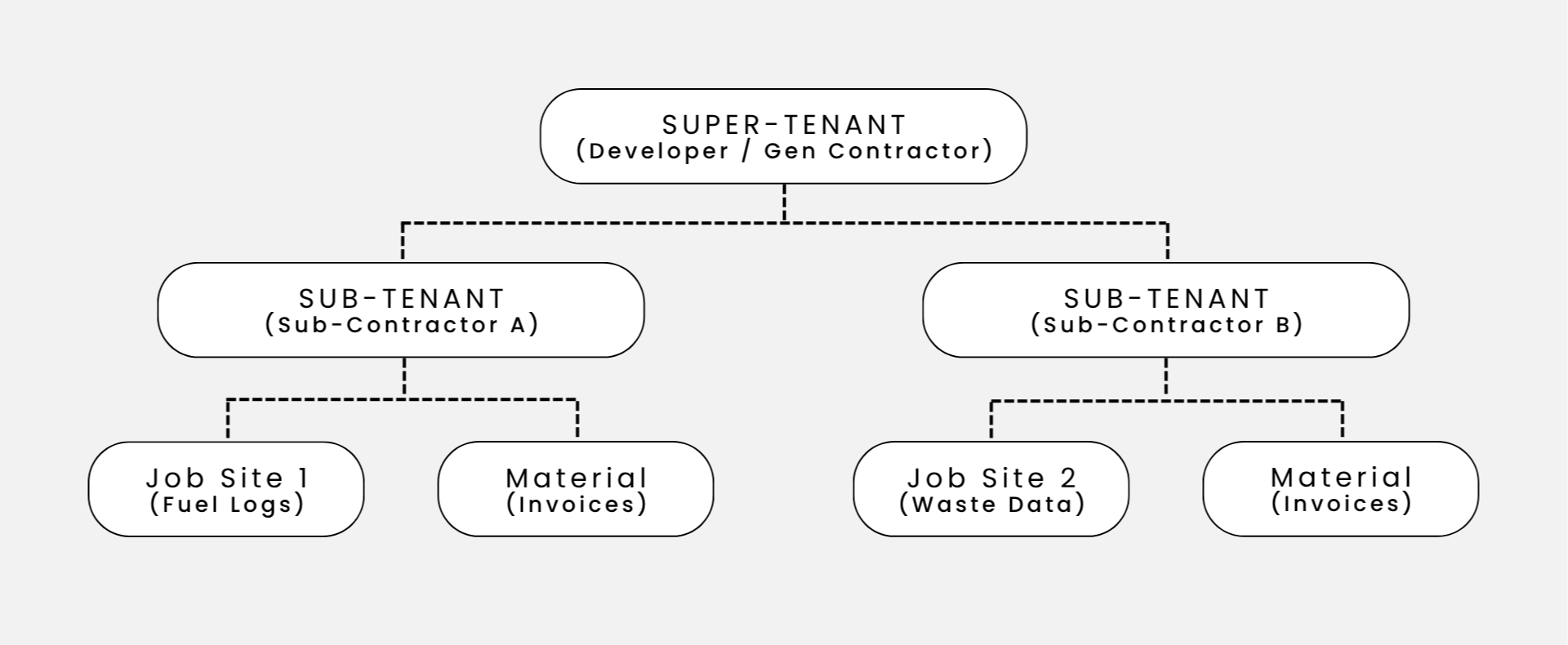
Under this architecture, the developer or general contractor operates as a Super-Tenant, establishing group-wide carbon reporting templates, data validation thresholds, and centralized compliance oversight. Each sub-contractor or vendor receives access to a secure, isolated Sub-Tenant workspace or interface.
This structure delivers an optimal balance of central governance and operational flexibility:
Secure Sub-Contractor Isolation: Sub-contractors securely log in to input material receipts, configure their localized vehicle fleets, or link their telemetry systems without exposing internal financial or operational data to other competitors on the same project.
Automated Data Consolidation: Site-specific information inputted at the sub-tenant level automatically rolls up into the Super-Tenant control tower. This offers executives a real-time, consolidated view of total carbon performance across all business units, active project sites, and trade categories.
Step 3: Streamlining Procurement and Supplier Alignment
While optimizing site-level energy and operational waste is essential, reducing the overall environmental footprint of a project requires bringing transparent, data-driven insights into the procurement lifecycle. Long before breaking ground, organizations can align their supply chains by tracking vendor carbon readiness and integrating standard sustainability baselines into contractor bidding processes.
Digital Vendor Onboarding and Readiness Assessments
A primary bottleneck in managing value chain emissions is understanding which sub-contractors possess mature carbon accounting workflows and which require additional support. By utilizing automated onboarding paths and structured supplier scorecards, general contractors can evaluate sub-contractor carbon reporting capabilities alongside traditional cost and safety metrics. This centralizes vendor compliance documentation, insurance certificates, and historical sustainability data in one accessible repository.
Integrating Carbon Benchmarks into Pre-Construction
By digitizing and centralizing project requirements, sustainability teams can establish clear, measurable carbon expectations during the estimating and bidding phases. Providing sub-contractors with accessible web interfaces or automated forms ensures that projected emissions factors are submitted transparently during procurement. This shifts the organization away from manual retroactive calculations, ensuring that potential environmental risks are identified and managed prior to contract assignment.
Sustaira as the Single Source of Truth for the Project Ecosystem
Executing a successful decarbonization strategy requires close collaboration between all entities within the construction value chain: architects, structural engineers, general contractors, and institutional developers.
Rigid legacy systems cannot support this level of ecosystem co-creation.

Sustaira serves as a flexible, centralized single source of truth across the entire asset lifespan:
During Design Phases: Architects and engineering teams use Sustaira’s Scenario Analysis and Sustainability Planner to model alternative specifications and project configurations, predicting environmental impacts before a project breaks ground.
During Execution Phases: General contractors and sub-contractors use the Construction Sustainability Suite to aggregate real-time field data, shifting the organization from manual administrative compilation to proactive operational management.
During Financial and Audit Cycles: Developers and institutional investors rely on traceable audit trails to generate verified, disclosure-ready reports tailored to frameworks like LEED, GRESB, CSRD, or the North American Contractor's Commitment.
By connecting value chain data, standardizing reporting methodologies, and automating job-site data workflows, construction leaders can successfully turn Scope 3 compliance into a clear source of competitive advantage and long-term operational value.
Are you ready to streamline your project footprint tracking?
Discover how Sustaira's Construction Sustainability Suite can automate your site data gathering and eliminate reliance on complex spreadsheets.
