
What Makes a Sustainability Leader Effective in 2026?

The role of the Chief Sustainability Officer (CSO) has reached a pivotal tipping point. For years, sustainability leadership was primarily focused on defining long-term climate commitments, publishing glossy annual ESG reports, and serving as the moral conscience of the organization.
That narrative has fundamentally shifted.
According to the 2026 Weinreb Group CSO Report, the corporate landscape is undergoing a structural realignment. For the first time in sixteen years, the absolute number of standalone CSO positions at public U.S. companies experienced a course correction, declining by 10%. However, this shift does not signal a retreat from environmental goals. Instead, it marks a transition into mature operationalization: 42% of CSOs report an increase in sustainability headcount embedded outside the central sustainability team, directly within business units, finance, procurement, and operations.
Furthermore, the reporting structure is evolving rapidly. The proportion of CSOs reporting directly to the CEO dropped from 33% in early 2025 to 14% in 2026, while reporting into legal and risk functions grew to 23%. Executive boards (88%) and core governance structures (87%) remain firmly committed to sustainability momentum, but they now expect tangible business value: top drivers of corporate value creation are now led by risk mitigation (62%) and cost savings (52%).
In 2026, effective sustainability leaders are no longer siloed advocates. They are corporate integrators who connect environmental performance directly to enterprise resilience, balance sheet optimization, and long-term commercial value.
1. The Core Skill Set Modern CSOs Need in 2026
Operating in today's business environment requires a distinct set of leadership capabilities. When senior sustainability executives were surveyed on what attributes are essential to succeed in 2026, three primary skill sets emerged:
Influencing Without Authority: Because execution is increasingly dispersed across logistics, IT, procurement, and manufacturing, successful leaders must drive cross-functional alignment without direct hierarchy.
Operating as a "Corporate Chameleon": Modern leaders must fluidly translate sustainability data into terms that resonate with diverse internal stakeholders, speaking the language of risk with Legal, ROI with the CFO, and uptime with Operations.
Bimodal Execution: Leaders must maintain high-level strategic foresight while remaining deeply grounded in granular operational metrics and auditability standards.
As Sophie Beckham, CSO of International Paper, observed:
"CSOs are the futurists of the corporate context. My mandate is to see around corners, build resilience into our business model, and create value that will help my company not just navigate but thrive when facing emerging risks and opportunities.
2. Navigating Political and Economic Uncertainty with Commercial Rigor
Corporate leaders in 2026 face significant external friction. The top three operational challenges identified by CSOs are market and economic uncertainty, evolving regulatory mandates, and geopolitical volatility.
Effective leaders do not allow external turbulence to paralyze their programs. Instead, they insulate their strategies by grounding sustainability initiatives in commercial discipline and operational efficiency.
Grounding Sustainability in Commercial Value
Rather than positioning decarbonization as a discretionary cost center, effective leaders emphasize business continuity, risk reduction, and margin preservation.
Decoupling Growth from Carbon: Under the leadership of CSO Alastair Child, Mars Incorporated has focused on decoupling overall corporate growth from total value-chain greenhouse gas emissions. By integrating carbon metrics into core procurement contracts and agricultural sourcing, Mars demonstrates that long-term decarbonization directly protects supply chain resilience and profitability.
Protecting Capital Efficiency: Efficient resource management, energy reduction, and waste stewardship deliver immediate operational cost savings. Furthermore, maintaining audit-ready ESG performance guards against greenwashing litigation risks and non-compliance penalties.
3. Building Influence Across Functions: From Siloed Office to Enterprise Integrator
The era of the isolated sustainability department has concluded. To execute meaningfully, effective CSOs partner across key functional domains to embed environmental data into daily operational workflows:
The CFO & Legal Alignment
With 23% of CSOs now reporting into legal departments and financial stakeholders demanding strict data integrity, partnering with finance and legal is essential. Leading CSOs work with finance to establish auditable carbon accounting standards aligned with global frameworks such as PCAF (Partnership for Carbon Accounting Financials) and CSRD.
For example, Siemens Financial Services Americas partnered with Sustaira to automate Scope 3 financed emissions calculations across their debt finance portfolio. By standardizing data governance to match financial accounting rigor, Siemens Financial Services Americas reduced its reporting workload by 40% while accelerating carbon risk evaluation.
The Operations & Procurement Alignment
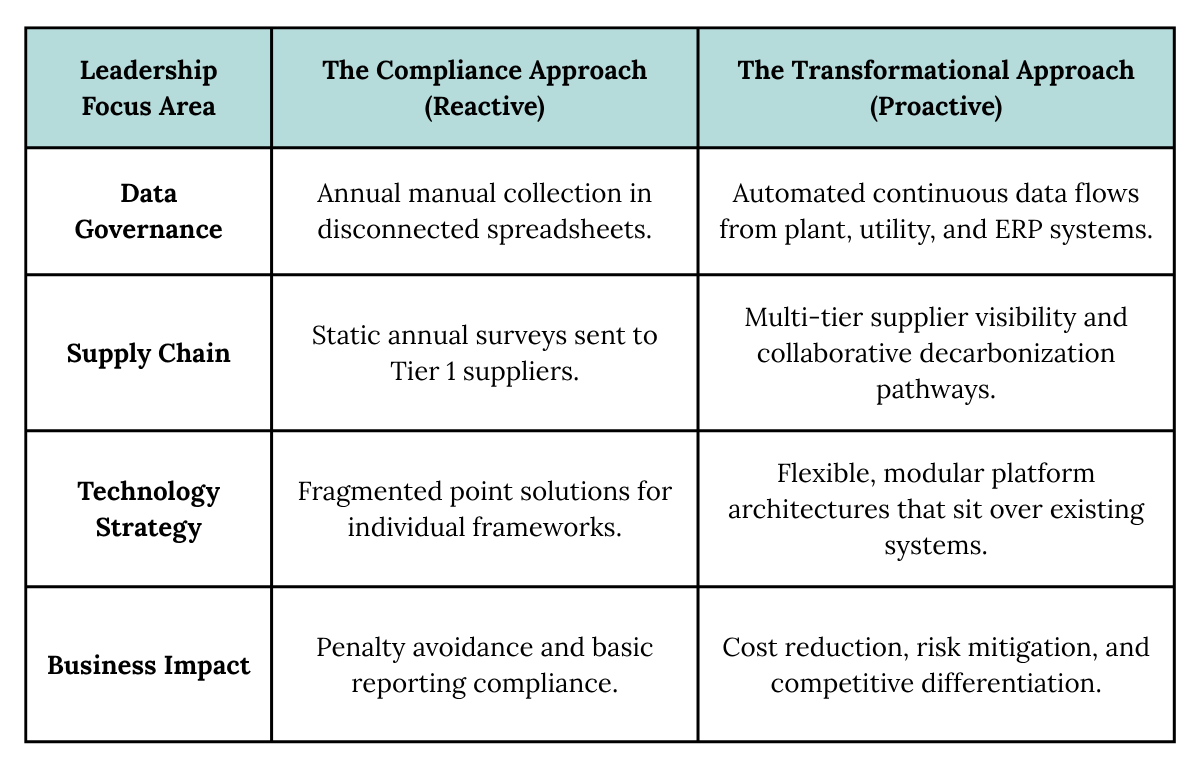
Scope 3 value chain emissions frequently represent 80% to 90% of an enterprise's overall impact, yet obtaining primary data from multi-tier suppliers remains a major obstacle. Effective sustainability leaders replace generic annual vendor surveys with standardized supplier portals and automated data intake mechanisms. This provides procurement leads with real-time supplier visibility, allowing them to make carbon-informed sourcing decisions without bottlenecking operations.
The CIO & IT Alignment
Modern sustainability requires a robust data architecture. CSOs work closely with Heads of Sustainable IT and enterprise architects to eliminate fragmented spreadsheets. By connecting sustainability software layers directly to existing enterprise resource planning (ERP) systems, operational technology (OT), and data lakes, organizations unify siloed inputs into a single source of truth.

4. Balancing Regulatory Compliance with Strategic Transformation
While complying with disclosure frameworks (such as CSRD, ISSB, and SEC rules) consumes significant bandwidth, focusing exclusively on compliance risks reducing the sustainability function to a reactive administrative exercises.
High-performing leaders use compliance as a foundational data layer, leveraging automated disclosures to free up strategic capacity for business transformation.
As Ann Tracy, CSO of Colgate-Palmolive, highlighted:
"We are focused on value-creating sustainability, with an eye on long-term growth and resilience. By building a healthy business that seeks to meet the needs of our stakeholders, we will continue working to achieve our targets, helping the planet win through our reduced environmental impact."
5. Leveraging Artificial Intelligence and Modular Architectures
Data volume across global, multi-unit operations is expanding rapidly. In the 2026 Weinreb Group study, 73% of CSOs reported that AI is having a moderate impact by driving operational efficiency, while 18% noted a significant impact that enables teams to focus on strategic initiatives.
Effective leaders are transitioning away from rigid legacy enterprise software and error-prone spreadsheets in favor of modular, AI-powered solutions:
Automated Data Extraction: AI utilities such as Optical Character Recognition (OCR) and Natural Language Processing (NLP) are deployed to scrape energy invoices, utility bills, and unstructured supplier uploads, mapping emissions data automatically to the correct carbon factors.
Targeted Implementation: Companies utilize modular software components to target immediate operational bottlenecks (such as Scope 1 and 2 tracking or facility waste stewardship) without committing to costly custom IT overhauls.
Predictive Scenario Planning: Forward-looking leaders use digital modeling tools to simulate financial and carbon trade-offs before allocating capital.
Actionable Takeaways for Sustainability Executives in 2026
To maximize organizational impact and strengthen executive alignment, consider implementing these four core practices:
Audit Your Team's Time Allocation: Evaluate how many hours your team spends manually gathering, reconciling, and cleaning spreadsheet data versus executing decarbonization projects. If reporting dominates, prioritize digital workflow automation.
Standardize on a Single Source of Truth: Unify fragmented data streams across business units into a central, auditable data layer aligned with recognized accounting standards like the GHG Protocol and PCAF.
Adopt a Flexible, Modular Tech Strategy: Avoid rigid software systems that force your team into static workflows. Implement flexible, API-driven solutions that integrate with existing ERP landscapes and scale as regulations evolve.
Frame Sustainability in Financial Terms: Position environmental targets around tangible business metrics: risk mitigation, cost reduction, operational efficiency, and lower cost of capital.
Accelerate Your Sustainability Impact with Sustaira
At Sustaira, we empower sustainability leaders to turn operational complexity into strategic clarity.
Sustaira provides a modular, AI-powered sustainability platform designed to integrate seamlessly with your existing enterprise systems. By unifying fragmented data, automating complex disclosure workflows, and providing real-time KPI tracking and scenario analysis, Sustaira enables your team to move beyond manual reporting and focus on driving measurable results.
Whether you need a targeted carbon accounting application, an industry-specific suite for manufacturing, construction, finance, or logistics, or a custom solution built around your unique corporate goals, Sustaira accelerates your journey from insight to action.
Discover how Sustaira can streamline your sustainability operations by connecting with our team today.
