Sustaira VS Osapiens
For organizations evaluating enterprise sustainability software, choosing the right platform is about more than the number of regulations supported or sustainability modules available.
The real question is how well the technology fits into your existing data architecture, how easily it can adapt to your organization's specific processes, and whether it can continue to support new sustainability priorities as requirements evolve.
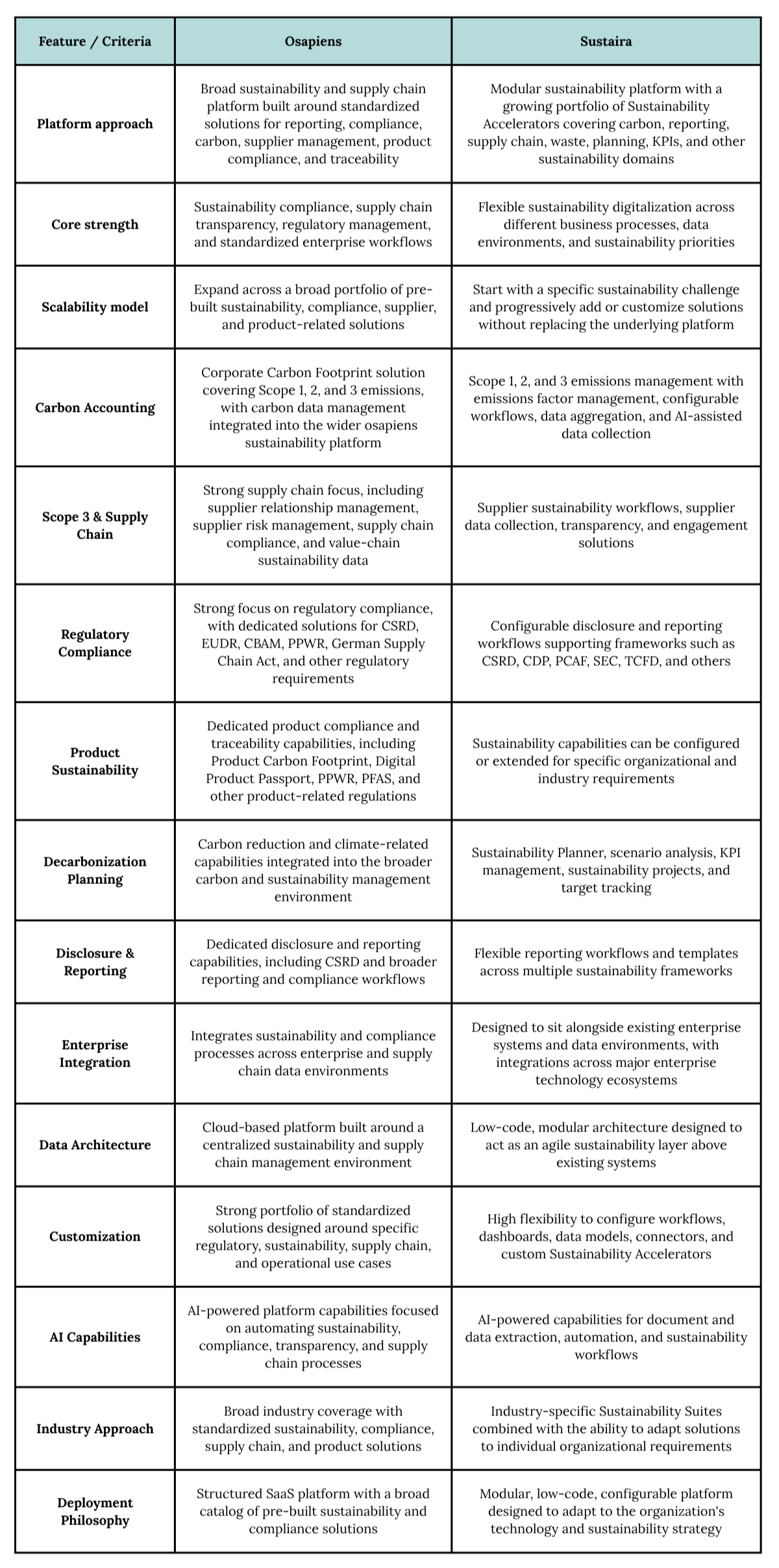
This guide provides a direct technical and operational comparison between Sustaira and osapiens. Both platforms address carbon management, sustainability reporting, supply chain requirements, and regulatory compliance, but they take different approaches to solving these challenges.
osapiens has built a broad sustainability and supply chain platform around standardized solutions for areas such as CSRD, corporate carbon footprint, CBAM, EUDR, PPWR, supplier risk, and product compliance.
Sustaira takes a more modular and flexible approach, combining sustainability-specific solutions with a low-code architecture that allows organizations to configure, integrate, and extend their sustainability environment around their existing enterprise systems.
Head-to-Head Comparison
Why Companies Choose Sustaira
When organizations compare Sustaira and osapiens, the decision is less about which platform covers more sustainability topics and more about how those capabilities are delivered and adapted to the organization.
Sustaira stands out for three key reasons.
1. One-Size-Does-Not-Fit-All: Build Around Your Organization
Every enterprise has different systems, organizational structures, data sources, reporting processes, and sustainability priorities.
A standardized solution can provide a strong starting point, but organizations often discover that their sustainability workflows do not perfectly match predefined processes. Sustaira takes a modular approach.
Organizations can start with a specific priority, such as Carbon Accounting, CSRD reporting, or sustainability KPI management, and then add additional Sustainability Accelerators as their needs evolve.
The platform can also be configured around the organization's existing workflows, data structures, and business processes. This means companies do not have to redesign their sustainability operations simply to fit the software.
2. Sustainability Technology That Works With Your Existing IT Landscape
Sustainability data rarely lives in one system. Emissions data can originate in ERP systems. Supplier information may sit in procurement platforms.
Operational data can come from industrial systems. Financial data may be managed separately, while reporting teams work with spreadsheets and specialized tools. Sustaira is designed to operate as an agile sustainability layer across this environment.
Its low-code architecture enables organizations to connect existing systems, aggregate sustainability data, build custom workflows, and introduce new sustainability capabilities without creating another isolated technology stack.
This is particularly relevant for large enterprises where sustainability software decisions increasingly involve both the Sustainability and IT functions.
3. From Pre-Built Software to Continuous Sustainability Digitalization
Implementing sustainability software is only the beginning.
Organizations still need to decide who owns the data, how information moves between departments, which processes should be automated, and how sustainability becomes part of everyday decision-making.
Through the Sustaira Sustainability Digitalization Program, organizations can address these challenges alongside the technology implementation.
Using the 3S Framework (Start, Structure, Scale) and the 5P Digitalization Pillars (Portfolio, People, Process, Platform, Promotion), Sustaira helps organizations align their sustainability strategy with their technology, data architecture, processes, and internal capabilities.
The result is not simply a sustainability software implementation. It is a foundation that can evolve as the organization's sustainability maturity increases.
osapiens is a strong choice for organizations looking for a broad, structured sustainability and supply chain platform with extensive pre-built capabilities around regulatory compliance, supply chain transparency, carbon management, and product-related requirements.
Sustaira takes a different approach.
It is designed for organizations that want the flexibility to build their sustainability technology environment around their existing enterprise architecture, processes, and priorities.
The distinction can be summarized simply:
osapiens helps organizations standardize and manage a broad portfolio of sustainability and compliance requirements.
Sustaira helps organizations build a flexible sustainability operating layer that can adapt as their business, data environment, and sustainability priorities evolve.
For enterprises with complex technology landscapes, multiple sustainability priorities, and a need for continuous digitalization, the question is therefore not simply:
"Which platform has the most sustainability features?"
It is: "Which platform can adapt to the way our organization actually operates, today and as our sustainability needs evolve?"