
The Ultimate Guide to Supplier Sustainability for Consumer Goods Companies
For a consumer goods company, sustainability does not stop at the factory gate.
It starts with the ingredients you source, the materials your suppliers use, the packaging around your products, the energy consumed by manufacturing partners, and the thousands of decisions made across your value chain every day.
That is what makes supplier sustainability so challenging for CPG companies. A single product can involve dozens of suppliers across multiple countries, tiers, materials, and production processes. Meanwhile, sustainability teams are increasingly expected to understand the environmental impact of that network, report on it with confidence, and actively reduce it.
The result is a difficult equation: More suppliers. More data. More regulations. More pressure to decarbonize.
Yet many sustainability teams are still trying to solve this with spreadsheets, supplier questionnaires, and fragmented data sources. That approach is becoming increasingly difficult to scale.
For CPG companies, supplier sustainability is no longer simply about collecting information from suppliers. It is about building the data, collaboration, and decision-making capabilities needed to turn a complex supply chain into a source of measurable sustainability impact.
Why Supplier Sustainability Is So Difficult for CPG Companies
Consumer goods supply chains combine almost every challenge sustainability teams face: global supplier networks, complex materials, high product volumes, packaging requirements, outsourced manufacturing, and significant Scope 3 emissions.
1. Your biggest emissions are often outside your four walls
For many CPG companies, the majority of their environmental footprint sits within the value chain rather than their own operations.
Raw materials, ingredients, packaging, contract manufacturing, transportation, and other upstream activities can all contribute significantly to Scope 3 emissions.
But knowing where emissions occur is very different from knowing how to reduce them.
If supplier-specific activity data is unavailable, companies often have to rely on spend-based calculations, industry averages, or secondary emission factors. These approaches can provide a starting point, but they make it harder to identify the suppliers, materials, and processes where decarbonization can have the greatest impact.
The challenge is moving from estimating your supply chain footprint to understanding it.
2. Supplier data is fragmented by design
A typical CPG company may receive sustainability information through:
Supplier questionnaires
Excel templates
PDFs and invoices
Procurement systems
ERP platforms
Supplier portals
Certification databases
Direct data integrations
And the information rarely arrives in the same format.
One supplier may provide energy consumption in kWh. Another may report emissions directly. A third may provide only annual spend. Others may send information buried in invoices or sustainability reports.
Without a structured way to ingest, validate, normalize, and connect this information, sustainability teams spend valuable time cleaning data instead of acting on it.
3. Packaging adds another layer of complexity
For CPG companies, sustainability extends beyond carbon.
Packaging materials, recycled content, recyclability, material composition, waste, and country-specific requirements all need to be considered.
Extended Producer Responsibility requirements are increasing the pressure on companies to understand what they put onto the market and what happens to those materials afterward.
That means sustainability data increasingly needs to connect products, materials, suppliers, markets, and waste streams rather than living in separate spreadsheets.
4. Suppliers are tired of answering the same questions
There is another side to the problem that is often overlooked.
Your suppliers are probably receiving sustainability questionnaires from your competitors too.
Repeated requests for similar information create reporting fatigue. Smaller suppliers may not have dedicated sustainability teams, while larger suppliers may have their own complex reporting processes.
The result is predictable: incomplete responses, inconsistent data, delayed submissions, and low engagement.
Better supplier sustainability programs do not simply ask suppliers for more data. They make it easier for suppliers to participate.
From Supplier Data Collection to Supplier Action
A mature supplier sustainability program should move through four stages:
Collect → Understand → Engage → Act
The goal is not to build the world's largest supplier database.
The goal is to know where your biggest sustainability risks and opportunities are, determine what action is possible, and measure whether that action is working.
Step 1: Build a Single Supplier Data Foundation
Start by bringing supplier sustainability information into a structured environment.
Instead of maintaining separate spreadsheets for carbon, packaging, sourcing, and compliance, create a common data layer that connects sustainability information to the suppliers, materials, products, sites, and business units it belongs to.
This allows sustainability teams to combine different levels of data maturity.
For example:
Supplier A provides verified Scope 1 and 2 emissions.
Supplier B provides energy consumption.
Supplier C provides production volumes.
Supplier D only provides spend data.
A strong sustainability data architecture should be able to work with all four without forcing the organization into a single methodology.
What to look for
Flexible data ingestion: APIs, connectors, forms, spreadsheets, invoices, and other sources should be supported.
Automated document processing: OCR and AI can help extract relevant sustainability information from invoices, certificates, and supplier documentation.
Multi-entity structures: Global CPG groups need to manage information across brands, subsidiaries, regions, and business units while maintaining appropriate governance.
Data lineage: Every number should be traceable back to its source, methodology, and calculation.
Step 2: Improve Data Quality Before You Make Decisions
More data does not automatically mean better data.
Before using supplier information for strategic decisions, sustainability teams need to understand its quality and consistency. This means standardizing units, methodologies, emission factors, reporting periods, and organizational boundaries.
It also means knowing where primary data exists and where estimates are still being used.
A useful supplier data hierarchy might look like this:
Primary activity data → Supplier-specific emission factors → Industry-specific factors → Spend-based estimates
The objective is not necessarily to eliminate estimates overnight. Instead, use them intelligently while creating a roadmap to progressively replace low-quality estimates with more granular supplier and activity data.
This creates a much more useful question than: "Do we have supplier data?"
The better question is: "How confident are we in the data driving our Scope 3 decisions?"
Step 3: Stop Treating Every Supplier the Same
Not every supplier deserves the same level of engagement.
A small office supplies vendor should not require the same sustainability process as a strategic supplier responsible for a high-carbon raw material.
Segment suppliers based on factors such as:
Carbon contribution
Spend
Material criticality
Geographic exposure
Regulatory risk
Product importance
Data maturity
Decarbonization potential
This allows sustainability teams to focus their resources where they can create the greatest impact.
For example, a CPG company could identify its highest-impact suppliers and establish targeted engagement programs around:
Renewable energy adoption
Energy efficiency
Low-carbon materials
Recycled content
Process improvements
Waste reduction
Supplier-specific emissions targets
This is where supplier sustainability starts to move from reporting activity to business impact.
Step 4: Turn Supplier Engagement Into Collaboration
Supplier engagement should not be a one-way request for information.
The most effective programs create a feedback loop: Company → Supplier → Data → Insight → Action → Measurement
Instead of simply asking a supplier to report its emissions, companies can use the data to have a more productive conversation:
Where are the supplier's largest emissions sources?
Which materials or processes drive them?
What reduction initiatives are already underway?
What investments would be required?
What support could the customer provide?
How can progress be measured?
For strategic suppliers, this can evolve into joint decarbonization programs rather than annual questionnaires.
That shift matters.
The supplier relationship becomes part of the decarbonization strategy.
Step 5: Connect Supplier Sustainability to the Rest of the Business
Supplier sustainability should not operate as an isolated sustainability initiative.
The most valuable supplier insights can influence decisions across procurement, product development, operations, finance, and supply chain management.
Imagine a procurement team comparing two materials.
Supplier A offers a lower purchase price but has a significantly higher carbon intensity.
Supplier B costs slightly more but uses recycled content and renewable energy.
With integrated sustainability data, procurement can evaluate both financial and sustainability implications rather than making the decision based solely on purchase price.
The same principle applies to product design.
If packaging teams can see the environmental impact of different materials, they can evaluate alternatives before a product reaches the market.
This is where supplier sustainability becomes a business capability rather than a compliance exercise.
The Metrics That Actually Matter
Collecting supplier data is not the same as improving supplier sustainability.
CPG companies should therefore measure both data maturity and real-world progress.
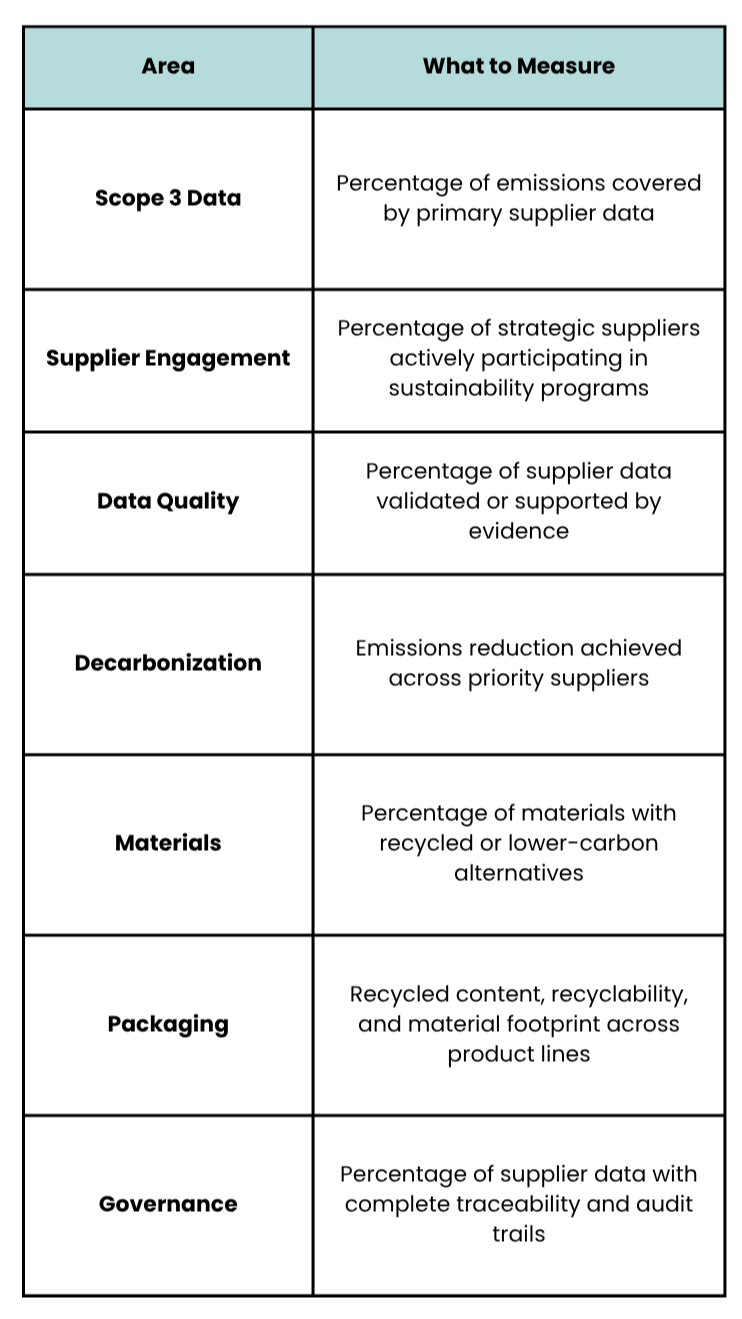
One particularly important metric is the shift from estimated to primary data.
If 70% of your Scope 3 footprint is currently based on estimates, the objective should not simply be to collect more supplier questionnaires.
It should be to progressively increase the portion of your footprint supported by high-quality, supplier-specific data.
What Does a Mature Supplier Sustainability Program Look Like?
A mature program should allow a sustainability leader to answer questions such as:
Which suppliers contribute most to our Scope 3 footprint?
Which materials are responsible for the greatest impact?
Where are we relying on estimates rather than primary data?
Which suppliers have credible reduction plans?
Where could procurement decisions reduce environmental impact?
How are our packaging choices affecting our footprint and regulatory exposure?
Can we trace every reported figure back to its source?
And perhaps most importantly:
Are our supplier sustainability initiatives actually reducing our environmental impact?
If answering these questions requires opening dozens of spreadsheets, requesting new data, and manually reconciling information, the organization has a data problem.
If the answers are available through a connected, continuously updated sustainability environment, the organization can start focusing on the decisions that matter.
From Supplier Reporting to Supplier Transformation
The next phase of supplier sustainability will not be defined by how many questionnaires a company sends or how much supplier data it collects.
It will be defined by what the organization can do with that data.
For CPG companies, the opportunity is significant. Better supplier data can improve Scope 3 accuracy, strengthen regulatory readiness, identify supply chain risks, inform procurement decisions, support packaging strategies, and uncover practical decarbonization opportunities.
The shift is therefore simple to describe, but transformative in practice:
From collecting supplier data → to understanding supplier impact → to collaborating on action → to measuring results.
Technology plays an important role in making that shift possible, but the objective should never be technology for its own sake.
The objective is a supplier sustainability program that is scalable enough for a global value chain, flexible enough to work with different supplier data maturity levels, and actionable enough to drive measurable change.
For CPG sustainability leaders, that is the real opportunity: turn the complexity of the supply chain from a sustainability challenge into a source of competitive advantage.
Is your supplier sustainability program still focused on collecting data, or is it already helping your organization decide where to act?
