
Why Supply Chain Risk in Manufacturing Is No Longer a Procurement Issue
For decades, supply chain management in the manufacturing sector was governed by a relatively simple set of variables: cost, quality, and speed. Procurement departments were the gatekeepers, tasked with squeezing efficiencies out of vendors to ensure just-in-time delivery.
Today, that paradigm has shifted fundamentally. For the modern Chief Sustainability Officer (CSO) and operations leader, the supply chain is no longer just a logistical challenge. It is the primary frontier for corporate risk and the single greatest lever for sustainability impact. In an era of evolving regulations and heightened stakeholder scrutiny, supply chain risk has officially migrated from the procurement back office to the center of strategic boardroom discussions.
The Shift from Logistical to Strategic Risk
In manufacturing, between 80% and 90% of a company’s environmental and social impact occurs within the supply chain. This vast, invisible footprint—often referred to as Scope 3 emissions—represents a significant concentration of hidden risks.
What makes this risk so potent for manufacturing leaders is its fragmented nature. Data is often scattered across thousands of Tier 1, Tier 2, and Tier 3 suppliers, residing in siloed systems, disparate spreadsheets, and non-standardized formats. This lack of visibility creates a dangerous blind spot for organizations. If a manufacturer cannot accurately see into its supply chain, it cannot effectively manage its exposure to:
Regulatory Non-Compliance: New standards such as the Corporate Sustainability Reporting Directive (CSRD), the Carbon Border Adjustment Mechanism (CBAM), and the EU Deforestation Regulation (EUDR) demand a level of data granularity that traditional procurement tools cannot provide.
Operational Disruption: Climate-related events or social inequities deep in the value chain can halt production just as effectively as a missing part.
Reputational Damage: Stakeholders increasingly hold brands accountable for the actions of their furthest suppliers.
Beyond Spreadsheet Hell
The traditional method of managing this risk, manual Excel tracking and reactive email surveys, is no longer viable. This spreadsheet hell is error-prone, inefficient, and fundamentally non-auditable. For a lean sustainability team at a $500M+ manufacturing enterprise, manual data consolidation is a drain on resources that could be better spent on actual decarbonization strategies.
The solution requires a transition to a Digital Sustainability Ecosystem. This means moving away from rigid, one-size-fits-all legacy systems and toward modular, AI-powered solutions that sit on top of existing IT infrastructure.
Turning Ambition into Measurable Action
Mitigating supply chain risk now requires a unified digital architecture. Forward-thinking manufacturers are deploying integrated portals to aggregate data from vast global supplier networks, bridging the gap between external partner inputs and internal master data systems.
By leveraging AI and modular architecture, manufacturers can:
Unify Disparate Data: Connect directly to ERP and OT systems (like SAP or Siemens) using pre-built connectors to automate the flow of carbon and operational data.
Automate Validation: Use AI to fill data gaps and validate inputs against industry-recognized emission factor libraries, ensuring the data is "audit-ready."
Perform Scenario Analysis: Model the impact of different supplier choices or material changes before committing resources.
Drive Collaboration: Move beyond passive reporting to engage suppliers in proactive decarbonization initiatives.
The Path Forward
Supply chain risk is the new operational reality for manufacturing. It is a challenge that demands a partnership between Sustainability, IT, and Procurement.
The goal is no longer just to "check the box" for compliance. It is to turn a complex web of data into a strategic advantage by reducing the cost of sustainability innovation, mitigating long-term risk, and delivering measurable impact. When sustainability is embedded into everyday decisions through transparent, data-driven insights, the supply chain stops being a source of risk and starts being a driver of value.
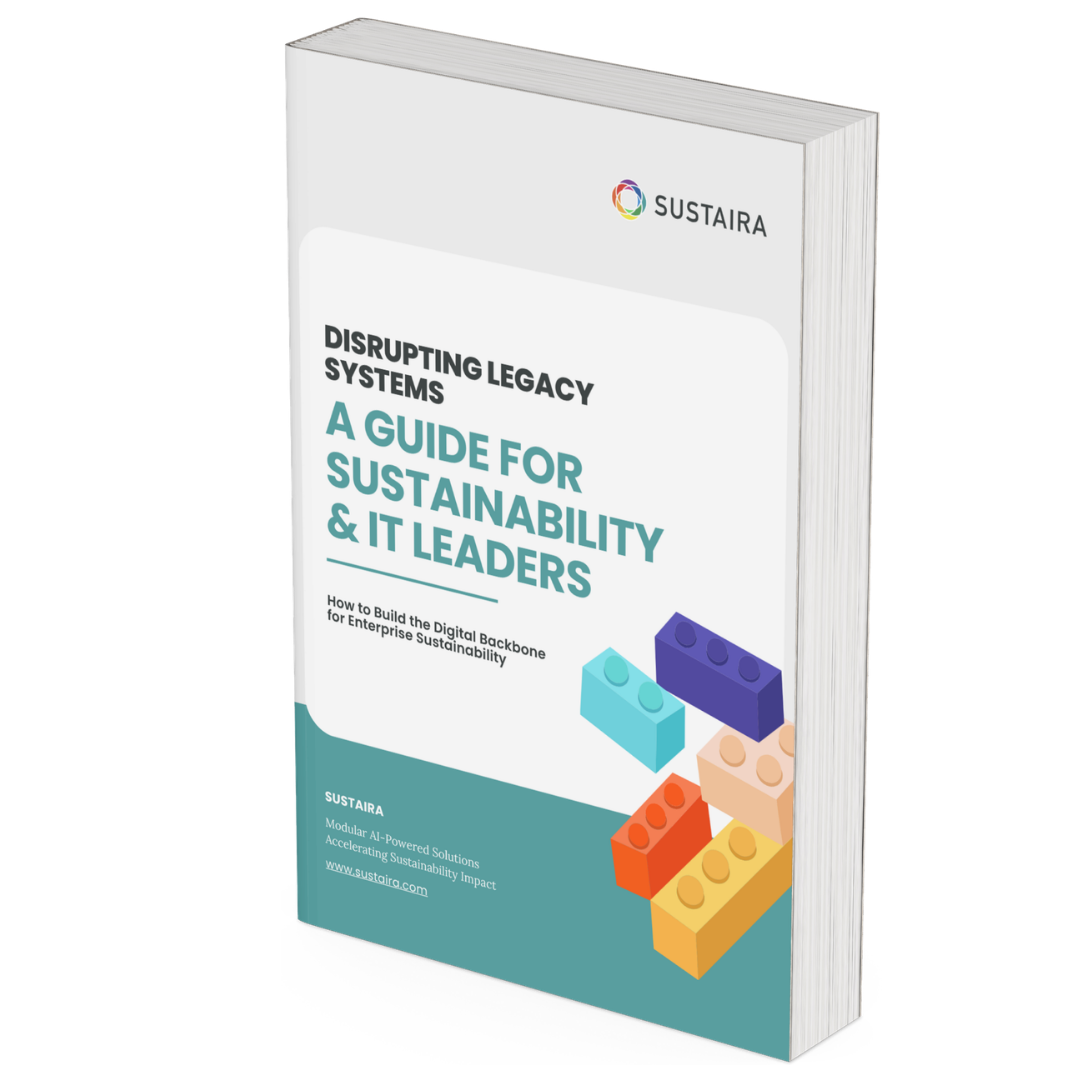
Disrupting Legacy Systems: How to Build the Digital Backbone for Enterprise Sustainability
This whitepaper provides a detailed perspective on how to design and implement this architecture.
It covers:
Principles of modular and composable sustainability platforms
Integration strategies across enterprise systems
The role of AI in managing sustainability data complexity
Governance, security, and multi-entity deployment models
As sustainability initiatives expand in scope and operational impact, the need for systems that scale, integrate, and adapt becomes critical.
Discover how to build a digital backbone that connects sustainability data with core business processes and enables consistent, enterprise-wide execution.
