
Disrupting Legacy Systems: How to Build the Digital Backbone for Enterprise Sustainability
Sustainability now sits at the core of enterprise operations.
Global organizations are scaling net zero targets, Scope 3 programs, and climate transition strategies while navigating increasing regulatory pressure and investor scrutiny. At the same time, many teams continue to rely on fragmented spreadsheets and disconnected sustainability software, creating gaps in data quality, visibility, and execution.
For enterprise IT leaders, the priority has shifted toward building systems that can support sustainability at scale.
Why Legacy Sustainability Systems Create Friction
Traditional sustainability tools were designed for periodic reporting. Today’s requirements demand continuous data flows across ERP systems, procurement platforms, and supply chain networks.
This mismatch creates operational friction:
Siloed data across business units and suppliers
Manual processes for data collection and validation
Limited real-time visibility into emissions and risk
Challenges in meeting auditability and compliance requirements
As sustainability metrics become embedded in financial and operational decisions, these limitations directly impact performance and risk management.
Building a Digital Backbone for Sustainability
Leading organizations are investing in a digital backbone for enterprise sustainability, a scalable infrastructure that connects data, systems, and decision-making.
Key elements include:
Modular sustainability platforms - Capabilities such as carbon accounting, supplier engagement, and scenario modeling are deployed as independent modules on a shared data foundation. This enables flexibility while maintaining consistency and control.
Enterprise integration - Sustainability data connects directly with ERP, procurement, and operational systems, enabling real-time insights within existing workflows.
AI-powered sustainability intelligence - Artificial intelligence supports data structuring, anomaly detection, and scenario simulation, improving both efficiency and decision quality.
Security and governance by design - Role-based access, data lineage, and secure supplier collaboration ensure compliance, transparency, and enterprise-grade trust.
The Expanding Role of Enterprise IT
Sustainability transformation increasingly depends on strong collaboration between IT and sustainability teams.
Enterprise IT leaders play a central role in:
Designing scalable data architectures
Managing integrations across complex system landscapes
Enforcing governance, security, and compliance
Supporting adaptability as regulations and methodologies evolve
This alignment enables sustainability to scale across business units, regions, and supplier ecosystems.
From Data to Operational Impact
With the right infrastructure in place, sustainability data becomes part of everyday decision-making:
Procurement evaluates supplier emissions during sourcing
Operations track decarbonization progress across facilities
Finance incorporates climate data into planning and investment decisions
Sustainability performance becomes measurable, actionable, and embedded across the enterprise.
Explore the Full Framework
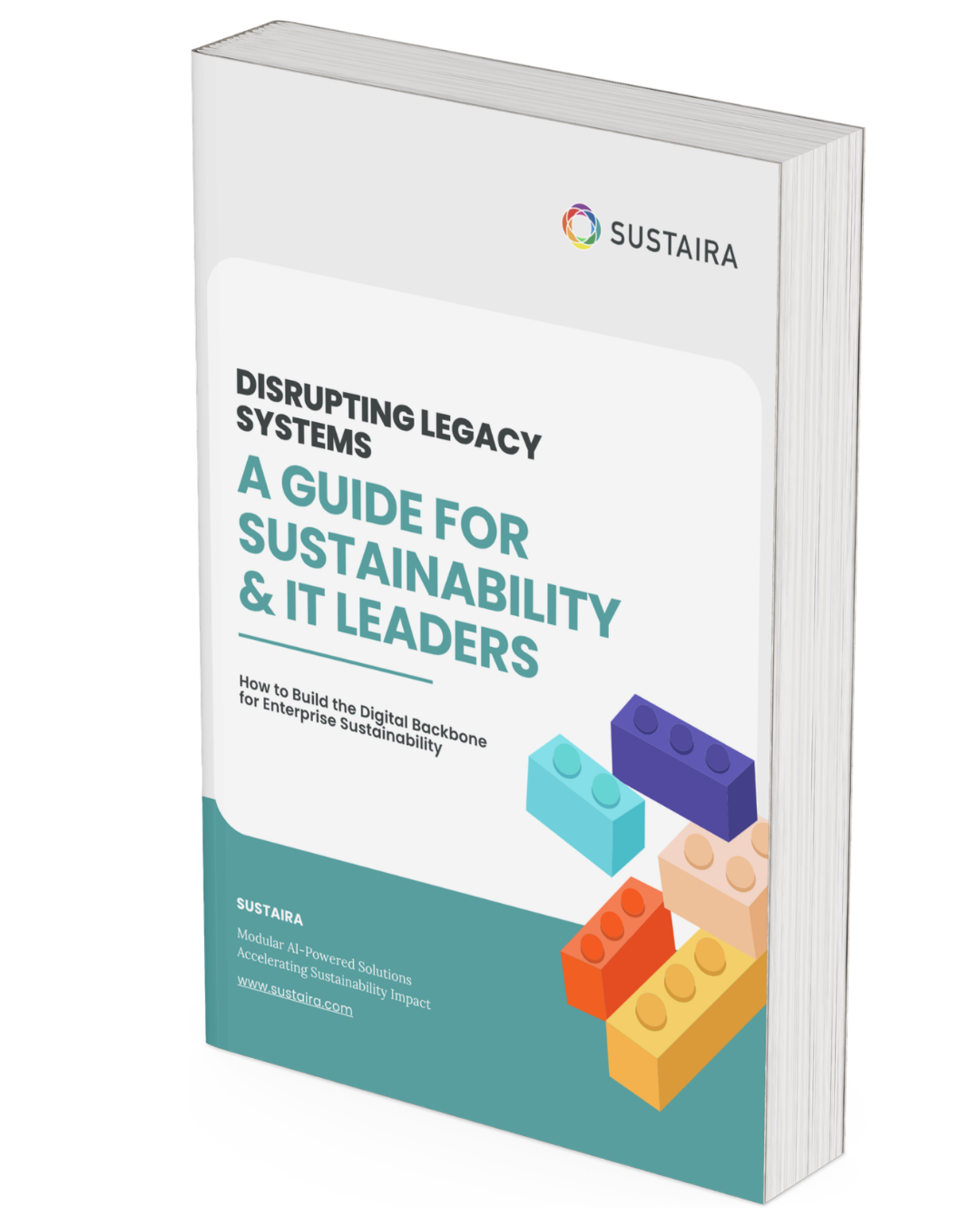
Sustaira’s whitepaper, “Disrupting Legacy Systems: How to Build the Digital Backbone for Enterprise Sustainability,” provides a detailed perspective on how to design and implement this architecture.
It covers:
Principles of modular and composable sustainability platforms
Integration strategies across enterprise systems
The role of AI in managing sustainability data complexity
Governance, security, and multi-entity deployment models
As sustainability initiatives expand in scope and operational impact, the need for systems that scale, integrate, and adapt becomes critical.
Discover how to build a digital backbone that connects sustainability data with core business processes and enables consistent, enterprise-wide execution.
