
Supply Chain Risk in Consumer Goods: The Growing Cost of Global Complexity
For Consumer Goods and Retail corporations, supply chain management used to be a game optimized purely for speed and cost. Dictated by just-in-time delivery models, the primary goal was keeping inventory low and moving goods from point A to point B as cheaply as possible.
Today, that calculation has drastically changed.
As multinational organizations navigate multi-region, multi-unit operations, the sheer complexity of global value chains has introduced severe financial, structural, and operational risks. What used to be a linear pipeline has transformed into a fragmented web of tier-1 suppliers, contract manufacturers, downstream distribution centers, and third-party logistics carriers.
In this new reality, corporate sustainability functions are no longer just handling annual compliance. They are operating on the front lines of strategic risk management.
The Operational Blind Spot: The Long Tail of Scope 3
For an enterprise consumer goods brand, over 80% of its total environmental footprint and climate vulnerability resides outside its own walls. This means that a company's greatest strategic risks are held by third parties.
The primary bottleneck for sustainability directors is a severe value-chain data gap. Relying on high-level estimates to map out supply chain emissions or resource constraints leaves an organization exposed. Without primary, activity-based data from actual suppliers—such as precise material weights, energy usage, and logistics routes—companies are flying blind.
This data gap doesn't just cloud carbon accounting; it hides structural vulnerabilities. If a tier-2 packaging supplier faces localized grid instability or changing regional material mandates, the downstream consumer brand bears the financial brunt of delayed shipments and disrupted product lines.
Fragmentation: The New Regulatory Friction
Navigating this supply chain complexity is further complicated by a highly fragmented global regulatory environment. Recent shifts and pullbacks at federal levels have stopped the arrival of a single, unified compliance standard.
Instead, multinational companies must handle a patchwork of localized, regional, and state-level rules. For instance, an organization operating across North America and Europe must align its data models simultaneously with California’s climate disclosure requirements, the European Union's Corporate Sustainability Reporting Directive (CSRD), and localized supplier codes of conduct.
Attempting to track, clean, and map supply chain data across multiple different regional frameworks using manual processes or static spreadsheets introduces massive administrative friction. It drains the productivity of sustainability teams and leaves the company vulnerable to severe audit and non-compliance risks.
The Greenwashing Crackdown and the Green Premium
The stakes for data accuracy have never been higher. Vague environmental claims like "responsibly sourced ingredients" or "low-impact packaging" are no longer just a public relations liability—they are a legal risk. Consumer protection authorities globally are enforcing heavy financial penalties on brands that make climate assertions without a verifiable, audit-ready data trail linking back to the primary source.
At the same time, brands are facing a commercial stand-off regarding the "green premium." While consumers vocalize a strong preference for traceable, sustainable alternatives, macroeconomic pressures limit their willingness to pay a premium price.
Consumer goods organizations cannot simply pass the costs of value-chain transformation onto the end consumer. To protect operating margins, sustainability teams must collaborate with procurement and finance to identify cost-effective decarbonization initiatives and find efficiencies directly within the supply chain.
Moving from Spreadsheets to Agile Integration
To mitigate these risks, organizations must stop treating sustainability data as a retrospective accounting project. Value-chain metrics must be managed with the same precision, auditability, and governance as financial records.
The solution is not to run a high-risk, expensive "rip-and-replace" overhaul of your core enterprise software. Instead, forward-thinking brands are introducing an agile integration layer that sits directly on top of existing IT systems (such as SAP, Salesforce, or Snowflake data lakes). This allows companies to seamlessly extract unstructured value-chain data, automate supplier collection workflows, and run dynamic scenario planning without disrupting day-to-day operations.
Take Control of Your Value Chain Complexity
Overcoming supplier data gaps, navigating regulatory fragmentation, and protecting corporate margins requires a practical, data-driven approach.
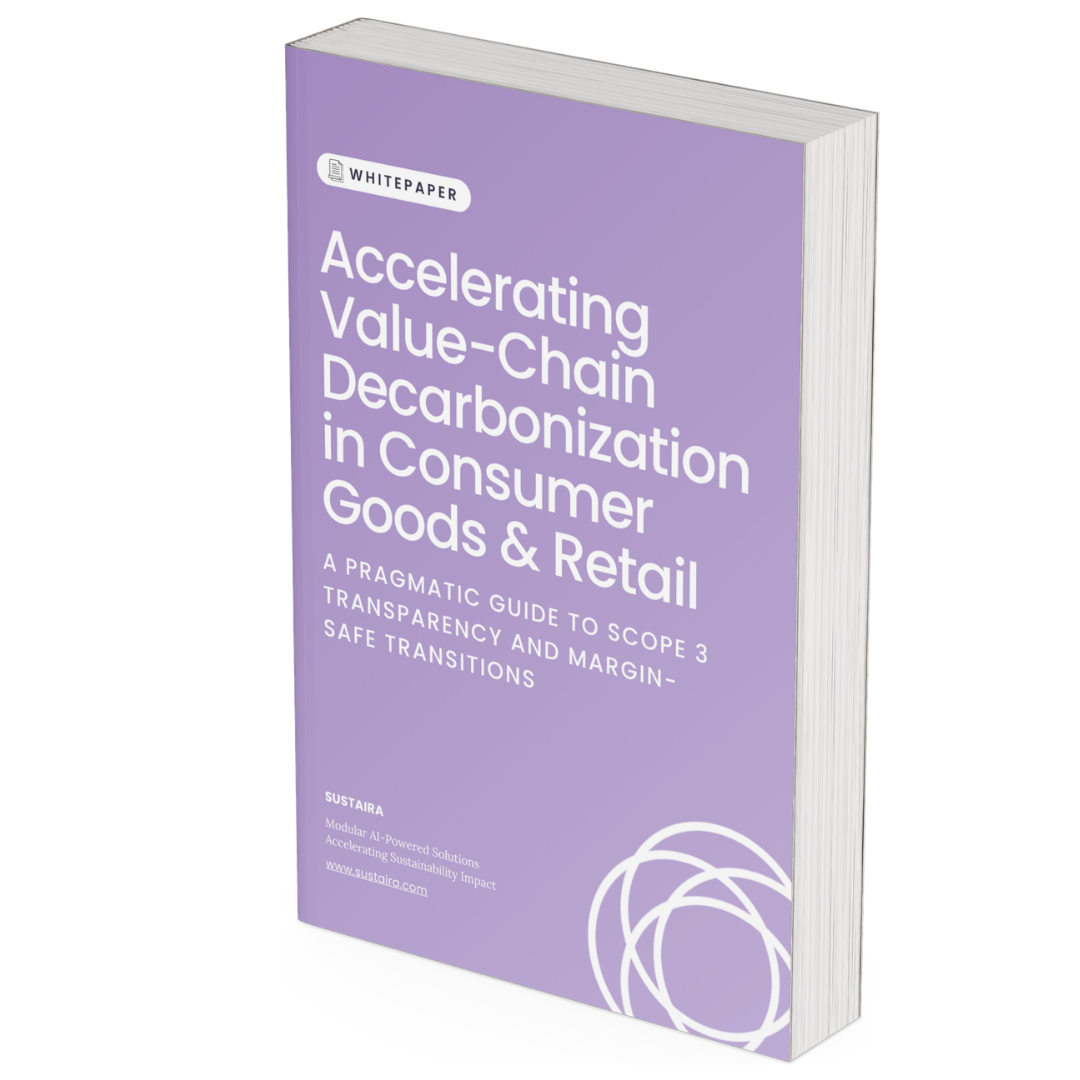
To help senior sustainability executives systematically address these operational challenges, we have published a comprehensive blueprint: Accelerating Value-Chain Decarbonization in Consumer Goods & Retail: A Pragmatic Guide to Scope 3 Transparency and Margin-Safe Transitions.
In this free executive guide, you will discover how Sustaira helps multinational consumer brands eliminate data holes and streamline compliance. Learn how our modular, AI-powered platform layers directly over your existing infrastructure to:
Automate primary value-chain engagement across thousands of suppliers.
Unify fragmented entity data across multi-brand holding companies.
Simulate capital investments, operational savings, and payback timelines with an interactive Scenario Planner.
Don't let value-chain complexity turn into a corporate cost center.
