
Why Most Sustainability Data Stacks Fail and What a Modern Architecture Looks Like

For many IT teams, sustainability data started as a peripheral concern handled in spreadsheets or a standalone CSR tool managed outside core systems. That has changed. With regulations such as CSRD in Europe and increasing expectations around financial-grade climate disclosures, sustainability data is now part of enterprise reporting and risk infrastructure.
This shift turns the sustainability stack into a core data architecture challenge. Yet many current implementations are not designed for that level of scale, integration, or auditability.
Why Current Sustainability Stacks Struggle
Most sustainability architectures today face a similar set of structural limitations.
1. Black box platforms and integration friction
Many early sustainability solutions were designed as self-contained platforms. While they may cover reporting needs, they often introduce challenges for IT teams: limited API flexibility, proprietary data models, and weak integration with existing data ecosystems such as data lakes or BI tools.
As a result, sustainability data becomes isolated. Extracting it for financial reporting, audit processes, or enterprise analytics often requires manual work or custom integration layers, increasing complexity and cost over time.
2. Fragmented and inconsistent data inputs
Sustainability data rarely originates in structured systems. It typically comes from utility invoices, supplier spreadsheets, estimates from operational teams, and other heterogeneous sources.
Traditional ETL processes are not always sufficient to handle this variability. The real challenge is not only ingestion, but also normalization, validation, and consistent mapping to emissions factors and financial data structures.
3. Scaling challenges across the value chain
Scope 1 and 2 emissions are relatively contained within organizational boundaries. Scope 3 introduces a fundamentally different challenge, requiring data from large and distributed supplier networks.
Without a modular and extensible architecture, systems quickly become difficult to scale. Data ingestion pipelines, calculation logic, and governance layers need to handle continuous growth in both volume and complexity.
What a Modern Sustainability Architecture Looks Like
Instead of a single monolithic platform, modern sustainability infrastructure follows a modular, composable approach that aligns with enterprise data architecture principles.
1. A decoupled sustainability data layer
Rather than replacing existing systems, sustainability data should be integrated into the existing enterprise data lakes, typically a cloud data platform such as Snowflake, Databricks, or BigQuery.
This approach ensures that environmental data becomes part of the organization’s governed data foundation, enabling consistency with financial and operational reporting. It also allows flexibility in swapping reporting tools or calculation engines without losing historical continuity or data lineage.
2. Intelligent data ingestion and validation
Modern architectures increasingly rely on automated ingestion workflows to reduce manual effort and improve data quality.
This includes:
Automated extraction of data from invoices and documents using OCR and NLP
Structured mapping of operational data to financial and emissions categories
Validation rules that detect anomalies, such as unexpected spikes in resource consumption, before data enters reporting workflows
The goal is not just ingestion, but reliable and auditable data preparation at scale.
3. Low-code extensibility for business teams
Sustainability requirements evolve quickly due to changing regulations and internal reporting needs. A rigid data model slows down adaptation.
Low-code extensibility allows sustainability and compliance teams to configure workflows such as supplier questionnaires, materiality assessments, or emissions calculations directly on top of governed data. This reduces dependency on engineering resources while maintaining IT oversight and control.
From Reporting Tool to Intelligence Layer
The role of sustainability systems is shifting from reporting output to enabling decision intelligence.
A well-architected system should support scenario analysis and forward-looking questions. For example, estimating the financial and environmental impact of transitioning logistics fleets or adjusting supplier networks should not require manual consolidation across multiple teams.
Instead, it should be available as a structured query on top of integrated and validated data.
The Takeaway for IT Leaders
Sustainability data is becoming part of the core enterprise data landscape. Treating it as a standalone reporting function creates fragmentation and long-term technical debt.
Organizations that succeed will not be those with the most complex tooling, but those with the most integrated, flexible, and scalable data architecture. The direction is clear: sustainability data needs to move into the governed enterprise data layer, where it can support both compliance and strategic decision-making.
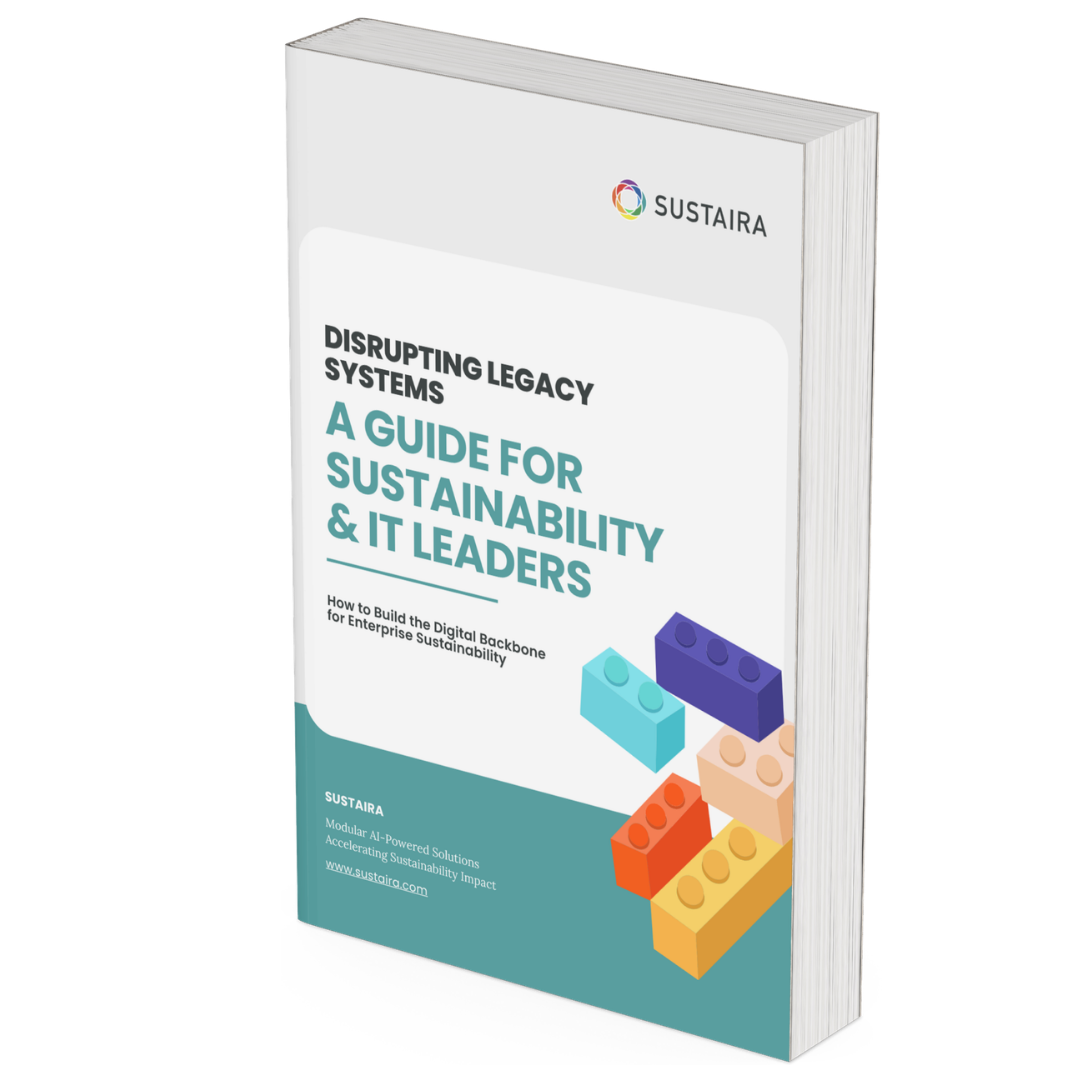
Sustaira’s whitepaper, “Disrupting Legacy Systems: How to Build the Digital Backbone for Enterprise Sustainability,” provides a detailed perspective on how to design and implement this architecture.
It covers:
Principles of modular and composable sustainability platforms
Integration strategies across enterprise systems
The role of AI in managing sustainability data complexity
Governance, security, and multi-entity deployment models
As sustainability initiatives expand in scope and operational impact, the need for systems that scale, integrate, and adapt becomes critical.
Discover how to build a digital backbone that connects sustainability data with core business processes and enables consistent, enterprise-wide execution.
