
Leveraging AI in Sustainability Management
Sustainability has become a data discipline.
What was once driven by policy statements and annual reports is now shaped by granular metrics, regulatory disclosures, investor scrutiny, and supply chain transparency. The ambition has grown. So has the complexity.
Behind every sustainability strategy lies a simple operational reality: documents. Invoices. Utility bills. Emission factor tables. Supplier statements. Policies. Regulatory questionnaires. Disclosure reports.
The real challenge is not setting targets. It is turning this vast, fragmented documentary universe into structured, reliable, and usable sustainability data.
This is where Sustaira applies artificial intelligence.
The Hidden Burden of Manual Sustainability Work
Much of sustainability management still depends on manual extraction and interpretation.
Teams upload invoices, utility bills, water and waste reports, disclosure documents, and long sustainability reports. They read through PDFs. They copy data into spreadsheets. They retype information into carbon accounting and reporting systems. They search across documents to answer structured disclosure requirements.
This work requires expertise. But it is repetitive, fragmented, and time intensive.
As regulatory pressure increases and reporting frameworks expand, the amount of documentation that must be processed continues to grow.
For sustainability leaders, this creates a structural challenge. Valuable expertise is often consumed by administrative tasks rather than strategic initiatives.
Artificial intelligence offers a way to address this imbalance.
What AI Means in Practical Terms
Artificial intelligence can often appear abstract, especially outside technical environments.
In sustainability management, however, its application is surprisingly concrete.
At its core, Sustaira applies AI to one essential task: transforming unstructured documents into structured sustainability data.
Two complementary technologies make this possible.
Optical Character Recognition, or OCR
OCR enables systems to read text from PDFs, scanned documents, invoices, and images. Information that once existed only as static text becomes machine readable.Intelligent document processing
Artificial intelligence then interprets that text, identifies relevant sustainability information, and organizes it into structured formats that can be used within operational workflows.
Together, these capabilities allow sustainability systems to move beyond manual data extraction and toward automated information pipelines.
Sustainability Focused OCR
Generic OCR reads characters. Sustaira understands sustainability.
While traditional OCR solutions simply convert text into digital content, Sustaira’s AI is trained to recognize sustainability specific information within documents.
It understands how operational data, reporting structures, and non financial metrics typically appear in invoices, environmental reports, and disclosure documents.
This allows the system to:
Extract sustainability related data from invoices and operational reports
Recognize relevant entities and structured fields
Recreate disclosure questionnaires inside the platform from uploaded files
Identify meaningful sections within sustainability reports
Convert extracted information into structured system inputs
Rather than treating documents as static files, Sustaira transforms them into operational data sources.
From Documents to Intelligence
Within Sustaira, these capabilities are applied across three practical workflows where sustainability teams traditionally spend significant time: capturing operational data, structuring disclosure frameworks, and accelerating future reporting.
Together, they create a continuous flow between documents, carbon accounting, and disclosures.
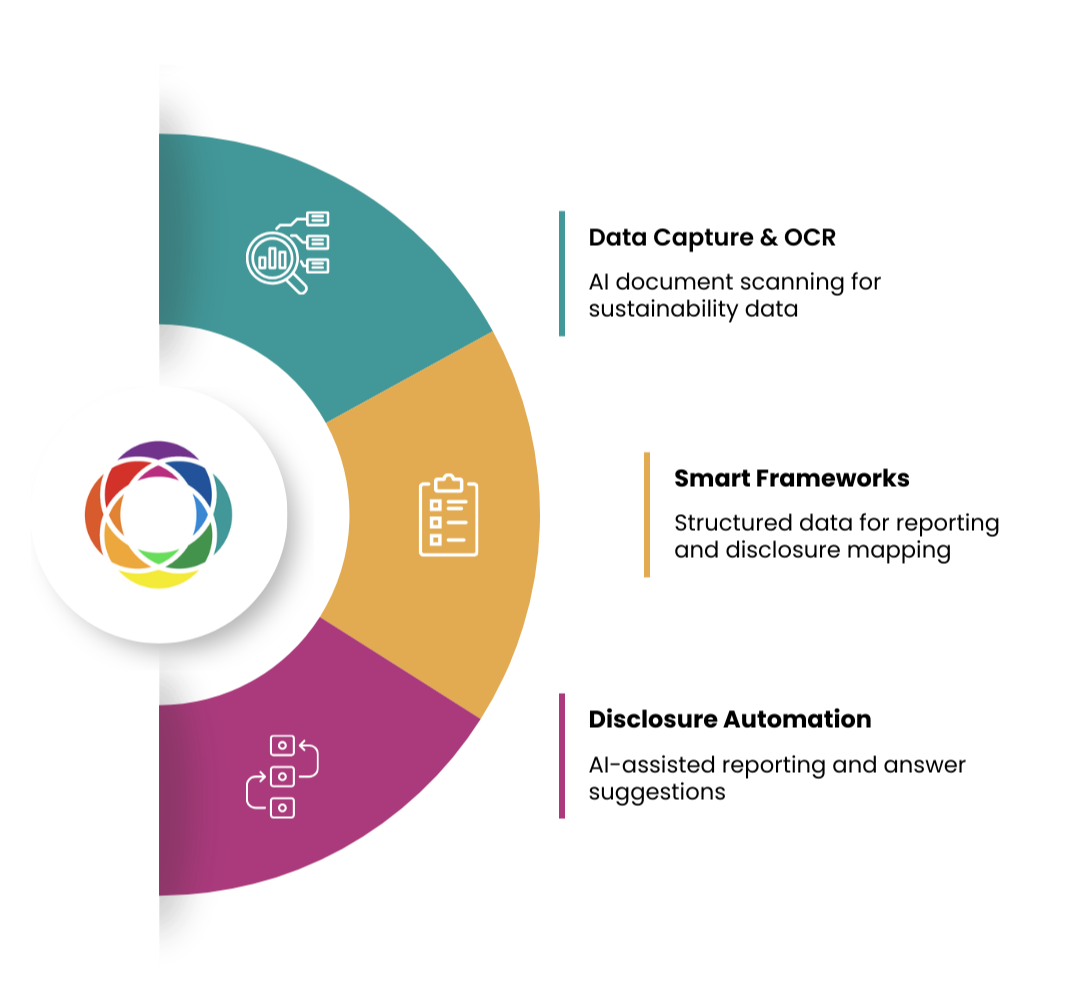
Data Capture
Invoices, water reports, and waste documentation often contain critical emissions and consumption information. However, these data points are typically embedded in unstructured documents.
Sustaira uses sustainability focused OCR to extract the relevant information directly from these documents and convert it into structured inputs.
The system can:
Extract sustainability data from operational documentation
Convert it into structured formats aligned with internal models
Feed the data directly into carbon accounting workflows
Reduce manual entry and minimize human error
This creates a seamless bridge between raw documentation and actionable sustainability metrics.
Smart Frameworks
Disclosure processes frequently begin with structured questionnaires that organizations must complete manually.
With Sustaira, teams can upload these questionnaires directly into the platform. OCR scans the document and recreates its structure within the disclosure solution.
This allows organizations to:
Import disclosure frameworks directly into the system
Automatically structure questions and reporting fields
Reduce repetitive form building
Maintain consistency across reporting exercises
Instead of manually recreating frameworks, sustainability teams can immediately focus on validating information and preparing responses.
Disclosure Automation
Disclosure reports often contain information that will be needed again in future reporting cycles.
Sustaira uses AI and OCR to analyze uploaded reports and identify relevant information that can support upcoming disclosures.
The platform can:
Scan sustainability and disclosure reports
Suggest responses based on existing documentation
Highlight supporting evidence within source files
Build a structured reporting inventory for future reference
Over time, this creates an institutional knowledge base that significantly accelerates future reporting processes.
Business Value for Sustainability Leaders
Technology matters only if it improves operational outcomes.
By embedding sustainability focused AI directly into data workflows, Sustaira delivers measurable value for sustainability teams.
Organizations benefit from:
Reduced workload through automated document processing
Higher data accuracy by minimizing manual transfers
Elimination of redundant data entry across systems
Improved traceability through structured data pipelines
Faster reporting cycles
Modular deployment options that scale with organizational needs
These improvements allow sustainability teams to focus less on administrative work and more on strategic initiatives.
Modular Deployment and Data Sovereignty
Enterprise sustainability environments often require strict governance and flexible technology architecture.
Sustaira’s AI capabilities are designed to be modular. Organizations can deploy them as standalone solutions or integrate them fully into broader sustainability workflows.
For organizations with strict data policies, deployment can also occur within the client environment. In this configuration, documents are processed securely without requiring storage within Sustaira systems.
This flexibility reflects a broader shift in sustainability technology: platforms must adapt to enterprise infrastructure rather than forcing organizations into rigid systems.
From Administrative Work to Strategic Impact
The true value of AI in sustainability management is not automation alone. It is the ability to reallocate expertise.
When repetitive document processing and data structuring tasks are automated, sustainability leaders gain time to focus on initiatives that create measurable impact:
Designing decarbonization strategies
Engaging suppliers and partners
Evaluating investment opportunities
Aligning sustainability performance with financial planning
Artificial intelligence does not replace sustainability leadership. It removes operational friction so leaders can focus on transformation.
The Next Evolution of Sustainability Infrastructure
As sustainability expectations continue to expand, organizations must rethink how information flows through their systems.
The future of sustainability management will not be defined solely by reporting frameworks or target setting. It will depend on the quality of the data infrastructure that supports them.
Platforms that can transform documents into structured intelligence will enable faster insights, stronger governance, and more reliable reporting.
By embedding sustainability focused OCR and AI directly into carbon accounting and disclosure workflows, Sustaira helps organizations build that infrastructure.
Not as an experimental capability, but as a practical foundation for accelerating sustainability impact.
