

Ask most sustainability leaders what their software roadmap looks like, and the answer is usually built around one thing: getting the report out. CSRD is coming, ESRS keeps evolving, the SEC has its own climate rules, and every one of those deadlines shapes what gets funded and prioritized. That's understandable. It's also a narrow way to think about the problem.
A reporting strategy answers one question: can we produce a compliant disclosure on time? A digitalization strategy answers a much bigger one: does sustainability data actually drive what the organization does next? Those are not the same project, and treating them as if they were is why so many sustainability programs feel like they're constantly scrambling instead of actually getting ahead.
The paradox at the center of most sustainability programs
Modern mandates like CSRD, SEC climate rules, and ESRS require dynamic, ongoing transparency. Most organizations are trying to meet that requirement with data still trapped in static spreadsheets and disconnected point solutions bought one at a time to solve one problem each. Traditional software often forces companies into a rigid structure that doesn't reflect how different business units actually operate, so teams end up building workarounds just to get a report finished.
That paradox doesn't resolve itself by buying a better reporting tool. It resolves by treating sustainability data the way finance treats financial data: as core enterprise infrastructure that many systems and teams draw on, not as a once-a-year output owned by one team.
Why IT and business operations can't be separate initiatives
Corporate sustainability challenges span both complex IT infrastructure and nuanced business operations. Treating those as separate projects, one led by IT, one led by the sustainability team, tends to produce disjointed data and failed adoption. The technical governance side and the business strategy side need to move in close, continuous alignment, not in sequence.
This is the core difference between a reporting strategy and a digitalization strategy. A reporting strategy can survive being owned by a small team with a spreadsheet and a deadline. A digitalization strategy requires shared ownership across IT, the sustainability function, and the business units that actually generate the data and act on the insights.
What a digitalization strategy actually looks like
A useful way to think about this is as an evolutionary path rather than a single big project. Organizations typically move through three phases:
Start. The focus here is centralizing data ingestion and replacing manual tracking with automated workflows to establish a verified baseline. This usually means picking one or two high-priority entry points, often carbon accounting or goals and KPI tracking, and getting them live quickly rather than trying to solve everything at once.
Structure. Once a baseline exists, the focus shifts to structured, automated reporting and governance. This is where regulatory disclosures and compliance reporting typically get formalized, alongside applications for things like supplier transparency or regional tracking. Internally, this phase usually means standing up a sustainability center of excellence and training internal teams rather than relying entirely on outside consultants.
Scale. This is where sustainability stops being a department-level activity and gets embedded into core business functions: risk, finance, supply chain, operations, and HR. Deep integration with enterprise data lakes, predictive scenario analysis, and automated target tracking start to make sustainability intelligence part of everyday corporate decisions, not a separate reporting exercise.
The five dimensions that actually determine success
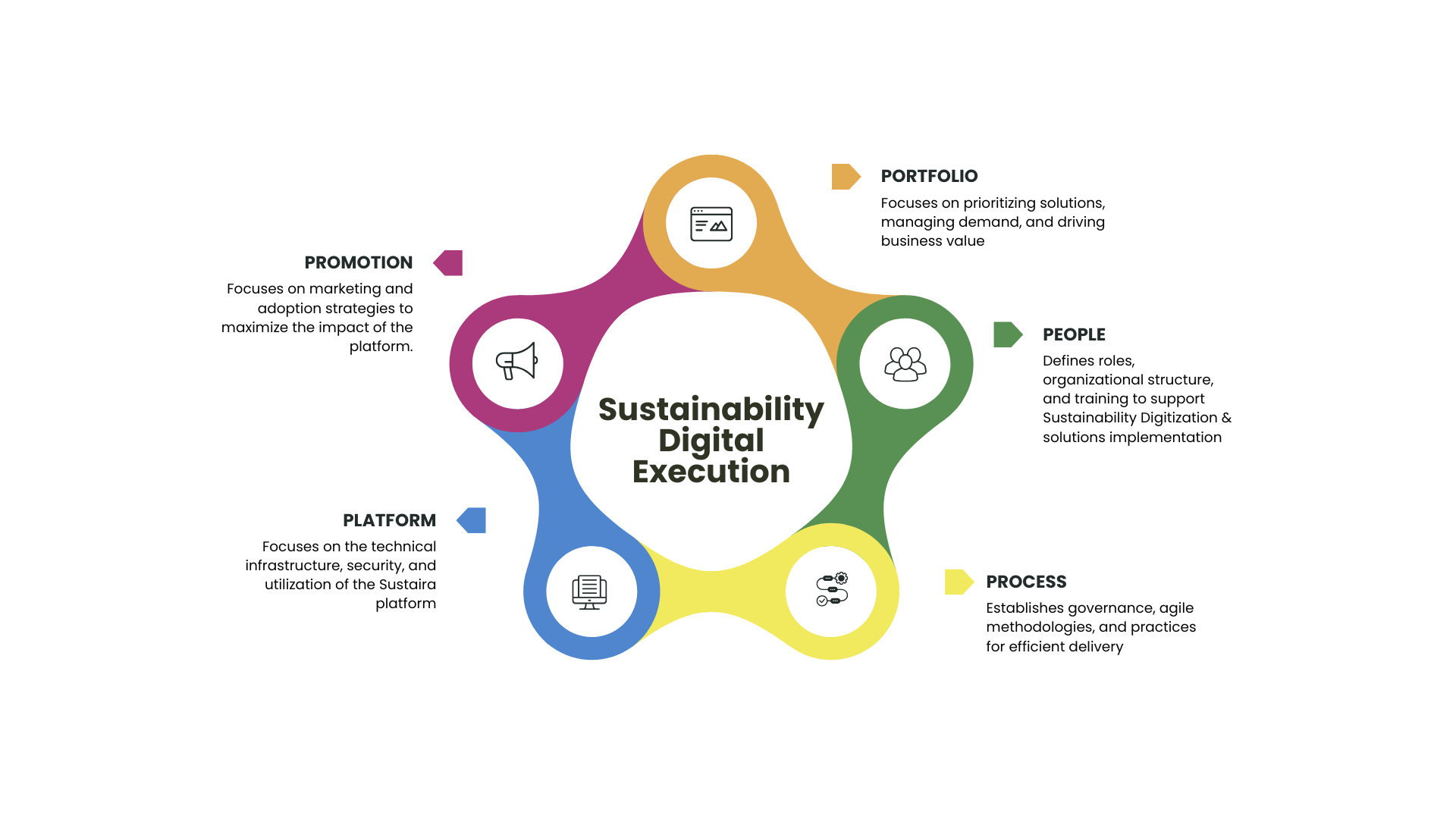
Technology alone doesn't get an organization through that path. Five things need to move together:
Portfolio: which solutions get prioritized, and in what order, based on business value and complexity
People: clear roles across IT, sustainability leadership, and business unit owners, so the platform doesn't rely on one overloaded team
Process: governance and delivery practices that can adapt as requirements change, instead of a rigid annual project plan
Platform: a technical architecture that connects to existing ERP, HR, and data lake systems instead of operating as an isolated tool
Promotion: making sure the data and insights actually reach the people who can act on them, internally and with external stakeholders, instead of living in a slide deck once a year
Skip any one of these and the others tend to stall. A great platform with no clear ownership becomes shelfware. Clear roles with no adaptable process become a bottleneck the moment a new regulation lands. A strong process with no real platform underneath it just formalizes the spreadsheet chaos instead of fixing it.
What this means for sustainability leaders right now
If your current roadmap is really just a list of reporting deadlines with software attached, it's worth asking a harder question: what happens to this data after the report is filed? If the honest answer is "not much," that's a sign the organization is optimizing for compliance instead of building a capability.
A digitalization strategy doesn't mean throwing out the reporting work already underway. It means building the underlying infrastructure so that work gets easier every year instead of harder, and so the same data that satisfies a regulator can also inform a supplier decision, a capital investment, or a risk assessment. Reporting becomes a byproduct of good infrastructure, rather than the entire point of it.
A structured path to get there
This is exactly the gap the Sustaira Sustainability Digitalization Program is built to close. Rather than a single rigid implementation, it's an adaptive, phased program built around the Start, Structure, Scale path and the five pillars of Portfolio, People, Process, Platform, and Promotion, so your technology, team, and processes stay synchronized at every stage instead of drifting apart.
The program pairs a modular, low-code platform with hands-on co-creation, embedding a Project Management Office, lead developer, and domain expert directly into the engagement, so the goal isn't just a successful go-live but real internal ownership by the time the work is done.
Explore the Sustainability Digitalization Program to see how a phased digitalization roadmap could work for your organization, or reach out to run a QuickStart assessment and map your own Start, Structure, Scale path.
