
How AI Is Revolutionizing Enterprise Sustainability Reporting in 2026
Meet the sustainability AI agents helping enterprises turn documents into knowledge, simplify supplier questionnaires, map emission factors and make sustainability data more actionable.
Enterprise sustainability reporting rarely starts with writing a report. It starts with finding the right information.
A sustainability manager might need to search through policies, previous disclosures, supplier questionnaires and operational documents to answer a single question. Another team might already have the answer, but the information is stored in a different format or system. Meanwhile, emissions data needs to be extracted, emission factors matched, and results checked before they can be used with confidence.
These repetitive tasks consume time and resources that sustainability teams could otherwise dedicate to improving performance and delivering measurable impact.
At Sustaira, we believe sustainability technology should adapt to the way organisations work, not force teams into rigid processes. Our AI agents extend this approach by taking on specific sustainability tasks, from extracting information from documents to matching emission factors and preparing evidence-based answers.
The objective is straightforward: less time processing information, more time accelerating sustainability impact.
1. Document-to-Knowledge-Base: Make existing enterprise knowledge work harder
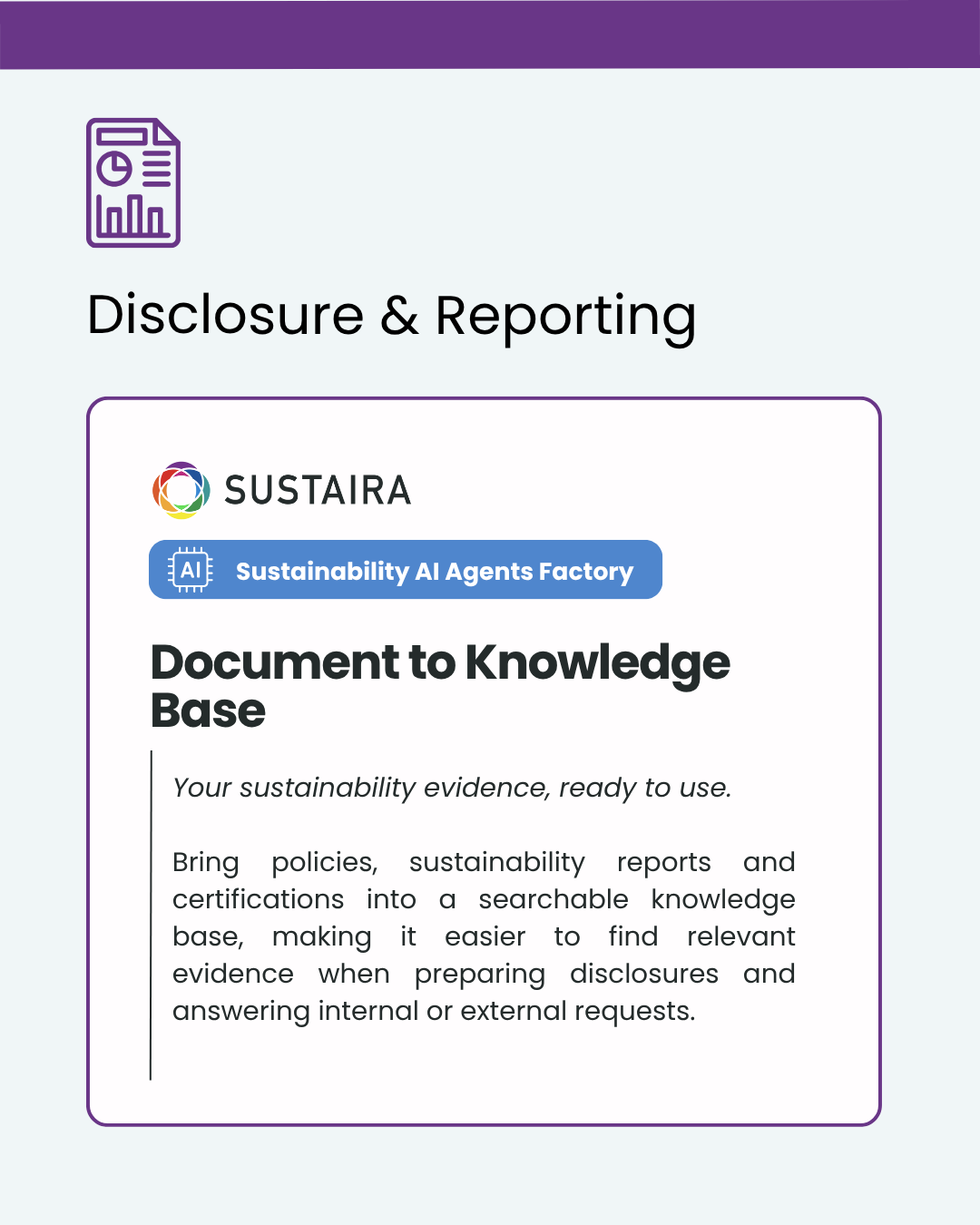
Organisations already have valuable sustainability information across policies, reports, certifications and other enterprise documents. The challenge is making that information accessible and reusable.
Sustaira's Document-to-Knowledge-Base agent helps transform existing documents into a structured semantic knowledge base. Rather than leaving information buried in individual files, it organises knowledge so it can be retrieved and used across subsequent workflows.
What does this mean in practice?
A sustainability team preparing a disclosure can ask a question and retrieve relevant information from its knowledge base. The team can draw on existing documentation instead of repeatedly searching for evidence or manually copying information between files.
The same knowledge can support different reporting requests, helping organisations reuse information across processes rather than treating every new questionnaire or disclosure as a separate exercise.
This approach turns document processing into a reusable foundation for sustainability work.
2. Question-Answering Agent: Find answers grounded in your own evidence
Once enterprise knowledge is structured and accessible, the next challenge is putting it to work.
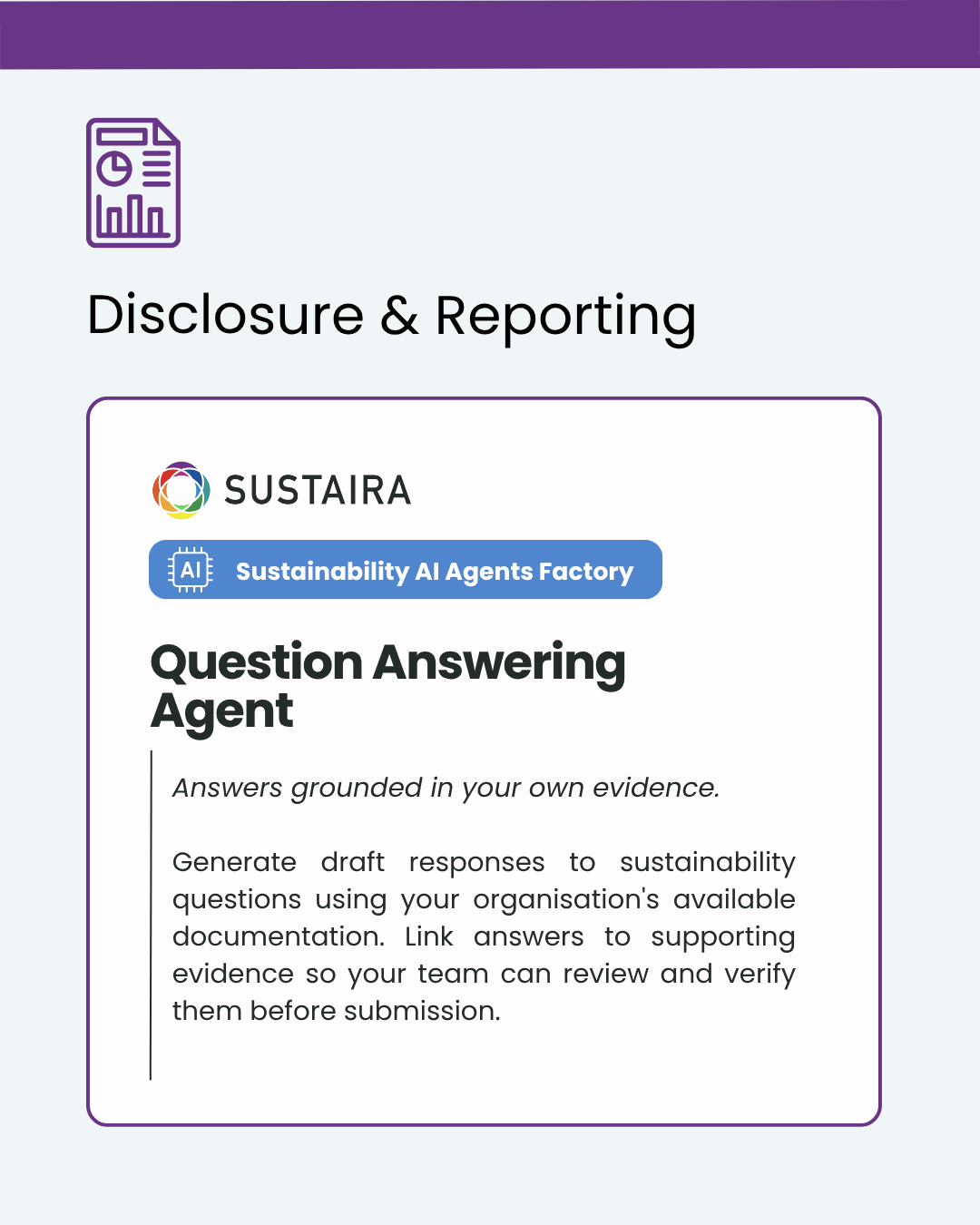
Sustaira's Question-Answering Agent helps teams prepare responses to sustainability questions using information available in their knowledge base. It can retrieve relevant evidence and draft answers with references to supporting sources, giving people a starting point they can review and verify.
For example, when preparing a sustainability questionnaire, a team may need to explain its environmental policy, provide evidence of a certification or describe an existing sustainability initiative. Instead of starting from a blank page, the agent can help identify relevant information and assemble a draft response.
The result is a more efficient way to reuse existing knowledge across reporting requests, while keeping source evidence available for review.
The goal isn't to remove human judgement from reporting. It is to reduce the time spent finding and assembling information so experts can focus on accuracy, completeness and the decisions behind the final response.
3. Document-to-Structured-Questionnaire: Connect supplier responses to reporting
Supplier engagement adds another layer of complexity to enterprise sustainability reporting.
Organisations often send questionnaires to suppliers to collect information about emissions, environmental practices, certifications and other sustainability topics. Responses arrive in different formats and must be reviewed, consolidated and transferred into internal processes.
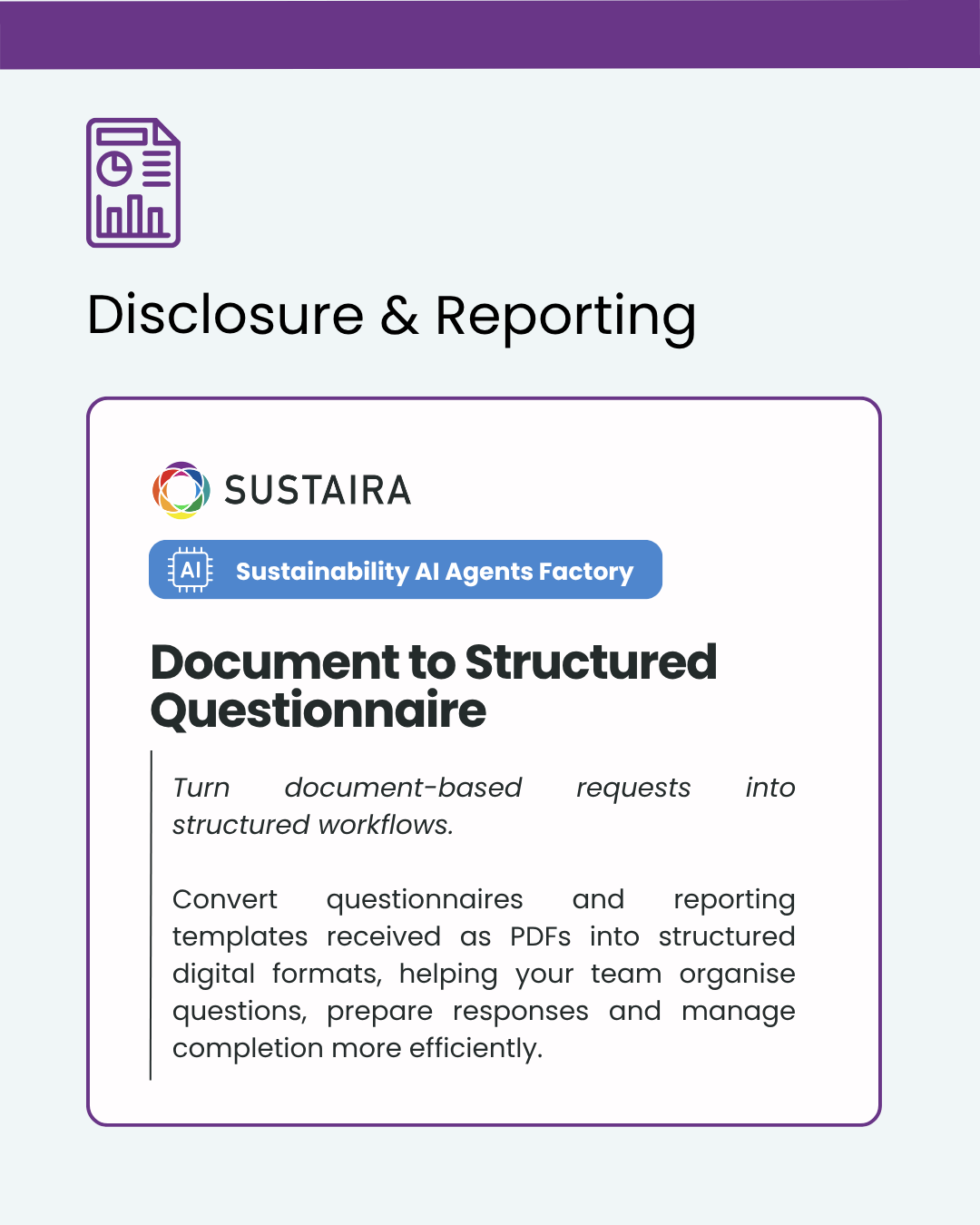
Sustaira's Document-to-Structured-Questionnaire agent helps turn questionnaire documents into structured digital templates, making information easier to collect and manage.
Once suppliers submit their responses, the information can be organised and made available for reuse in the enterprise knowledge base. Depending on the workflow, relevant responses can also support reporting questions or be routed into appropriate carbon accounting processes.
This creates a connection between supplier engagement and internal reporting.
Instead of treating each questionnaire as a standalone administrative task, organisations can build a more reusable body of supplier knowledge, reducing duplicated effort and making relevant information easier to retrieve when new requests arise.
4. Emission-Factor-Mapping: Connect activity data to the right factors
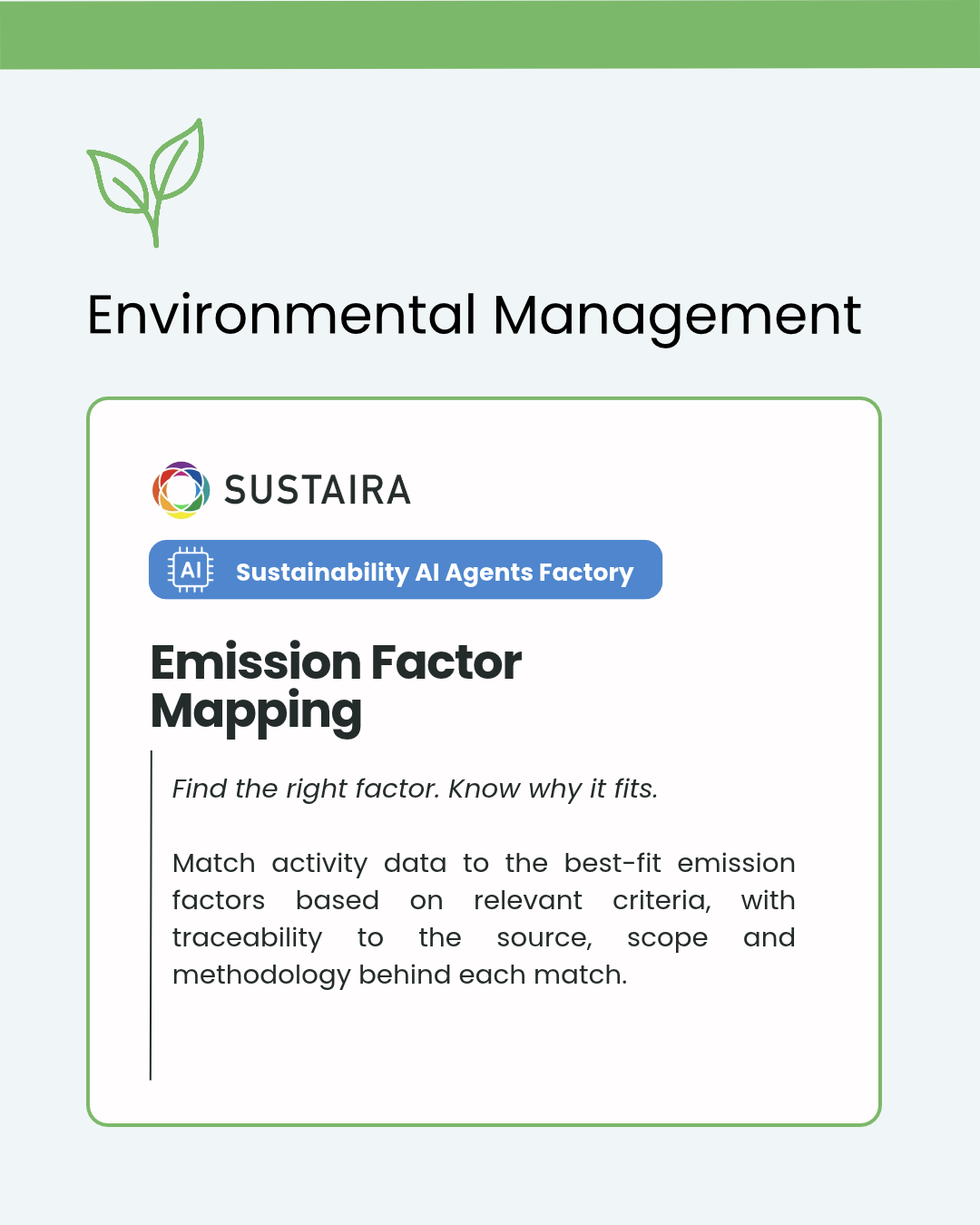
Collecting emissions activity data is only part of carbon accounting. Organisations must also identify suitable emission factors and understand the methodology behind each selection.
Sustaira's Emission-Factor-Mapping agent helps match activity data to the best-fit emission factors, with traceability to the source, scope and methodology behind each match.
This is particularly relevant when teams work with data from different locations, reporting periods, suppliers or operational systems. Finding and documenting appropriate factors can require detailed research and repeated manual checks.
By supporting factor resolution and making the basis of each match visible, the agent helps teams streamline this step while retaining the information needed to review and verify the result.
The benefit is not simply faster mapping. It is a more structured process in which teams can understand why a factor was selected and where further validation may be needed.
5. Table-to-Carbon-Accounting: Turn fragmented data into usable inputs
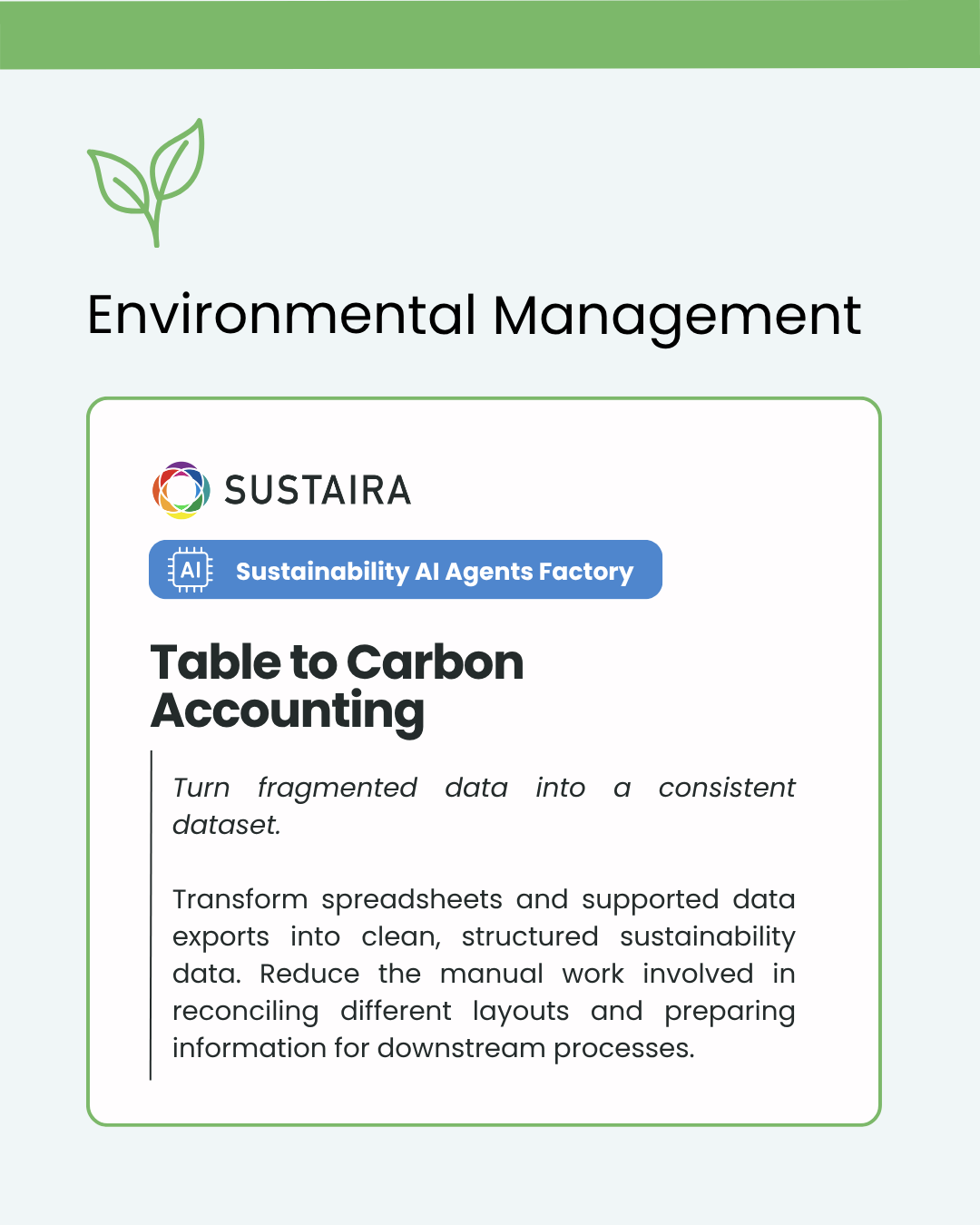
Not all sustainability information arrives in documents. Much of it sits in spreadsheets, exports and structured data feeds with different layouts and conventions.
Sustaira's Table-to-Carbon-Accounting agent helps transform supported tables and data exports into clean, structured information that can be used in carbon accounting workflows.
This reduces the manual effort involved in reconciling formats and preparing data for downstream processes. Instead of repeatedly reworking similar datasets, teams can establish a more consistent approach to bringing activity data into their sustainability workflows.
Combined with document processing and emission factor mapping, this helps connect different stages of the data preparation process.
The result is a more practical path from fragmented inputs to structured carbon accounting data, ready for the appropriate validation and review.
6. Document-to-Carbon-Accounting: From Invoices to Structured Carbon Data
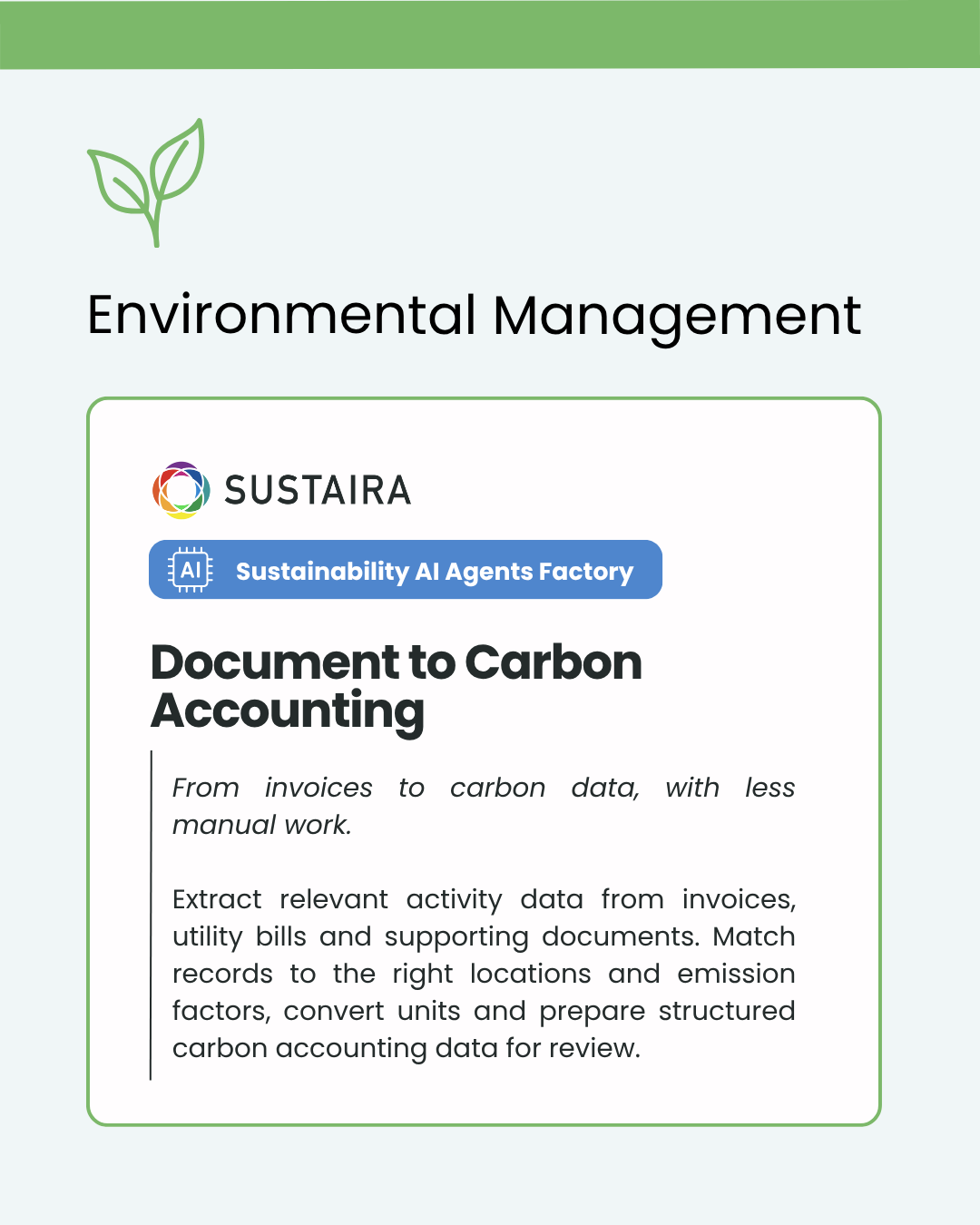
Carbon accounting often starts with information scattered across utility bills, invoices and supporting documents. Teams must manually extract activity data, identify the relevant locations, convert units and determine which emission factors apply.
Sustaira’s Document-to-Carbon-Accounting agent helps streamline this process by extracting relevant activity data from documents, matching records to the right locations and emission factors, converting units, and preparing structured carbon accounting data for review.
Instead of spending hours transferring information between documents and spreadsheets, sustainability teams can focus more of their time on reviewing data, investigating gaps and using the results to inform decisions.
The goal is not to remove human oversight. It is to reduce repetitive data preparation while keeping the resulting information available for review before it is used in carbon accounting.
Beyond individual agents: A connected approach to sustainability work
Each agent addresses a specific task, but the broader opportunity is to connect them into workflows that reflect how sustainability teams actually operate.
Consider a reporting process that begins with existing enterprise documents, incorporates supplier responses, maps activity data to emission factors and prepares information for carbon accounting or disclosure questions.
Each stage contributes to the next. Information extracted from documents can become reusable knowledge. Supplier responses can support future reporting requests. Activity data can be structured and matched to relevant factors. The resulting information can then support reporting and analysis.
This is where Sustaira's modular approach matters. Organisations can focus on the workflows that create the most value for them, rather than adopting a rigid, predefined process.
The Sustainability AI Agent Factory
Sustaira's AI Agent Factory is where specialised agents and workflows are built, tested and improved.
It combines four building blocks:
Agents perform tasks that require judgement, such as extracting information or identifying suitable emission factors.
Tools carry out defined programmatic actions, such as calculations and unit conversions.
Guardrails help keep AI within defined boundaries and support validation.
Context provides the relevant data, instructions, documents and standards an agent needs to perform its task.
Before deployment, workflows are tested against known-answer cases. After deployment, customer feedback can help improve customer-specific adaptations, with changes tested before they go live.
The Sustainability AI Control Console
Automating sustainability work also requires control over how agents operate.
The AI Control Console provides a central place to govern workflows, define where human reviews are required, manage access and security boundaries, and monitor performance, usage and value.
Organisations can establish which workflows are enabled, what agents are permitted to access and where people must approve outputs or trigger consequential actions.
This is particularly important for enterprise reporting, where information must be reviewed carefully and accountability cannot simply be delegated to an AI system.
The Factory and Control Console work together to make automation more practical, measurable and governed.
Accelerating sustainability impact, one workflow at a time
Sustainability teams do not need more technology for its own sake. They need practical ways to reduce manual work, make better use of existing information and turn sustainability data into decisions.
Sustaira's AI agents are designed around these needs. By helping teams structure enterprise knowledge, prepare questionnaire responses, map emission factors and organise carbon accounting data, they address specific sources of friction in sustainability reporting.
The broader objective reflects Sustaira's mission to Accelerate Sustainability Impact through three outcomes:
Enhanced productivity: Reduce repetitive work so sustainability teams can focus on higher-value activities.
Cost reduction: Make reporting and data processes more efficient, reducing the effort required to deliver sustainability outcomes and innovation.
Risk mitigation: Support traceability, validation and actionable insights so teams can make decisions with greater confidence.
The best place to start is with a specific workflow where manual effort is high and information is difficult to reuse. From there, organisations can evaluate the results, strengthen their processes and expand where the value is clear.
Want to see how Sustaira's AI agents could support your sustainability workflows?
Explore Sustaira AI and discover how the AI Agent Factory and AI Control Console help sustainability teams automate repetitive work while keeping people in control.
Join Sustaira for a practical webinar exploring how AI can support sustainability professionals in their daily work, free up time for strategic priorities, and help organizations scale their sustainability efforts with confidence.
Discover how Sustaira approaches AI for sustainability, explore our Sustainability AI Control Console, and see our new Sustainability AI Agents in action.
