
Manufacturing 2030: Why the Green Industrial Revolution Will Be Won on Data
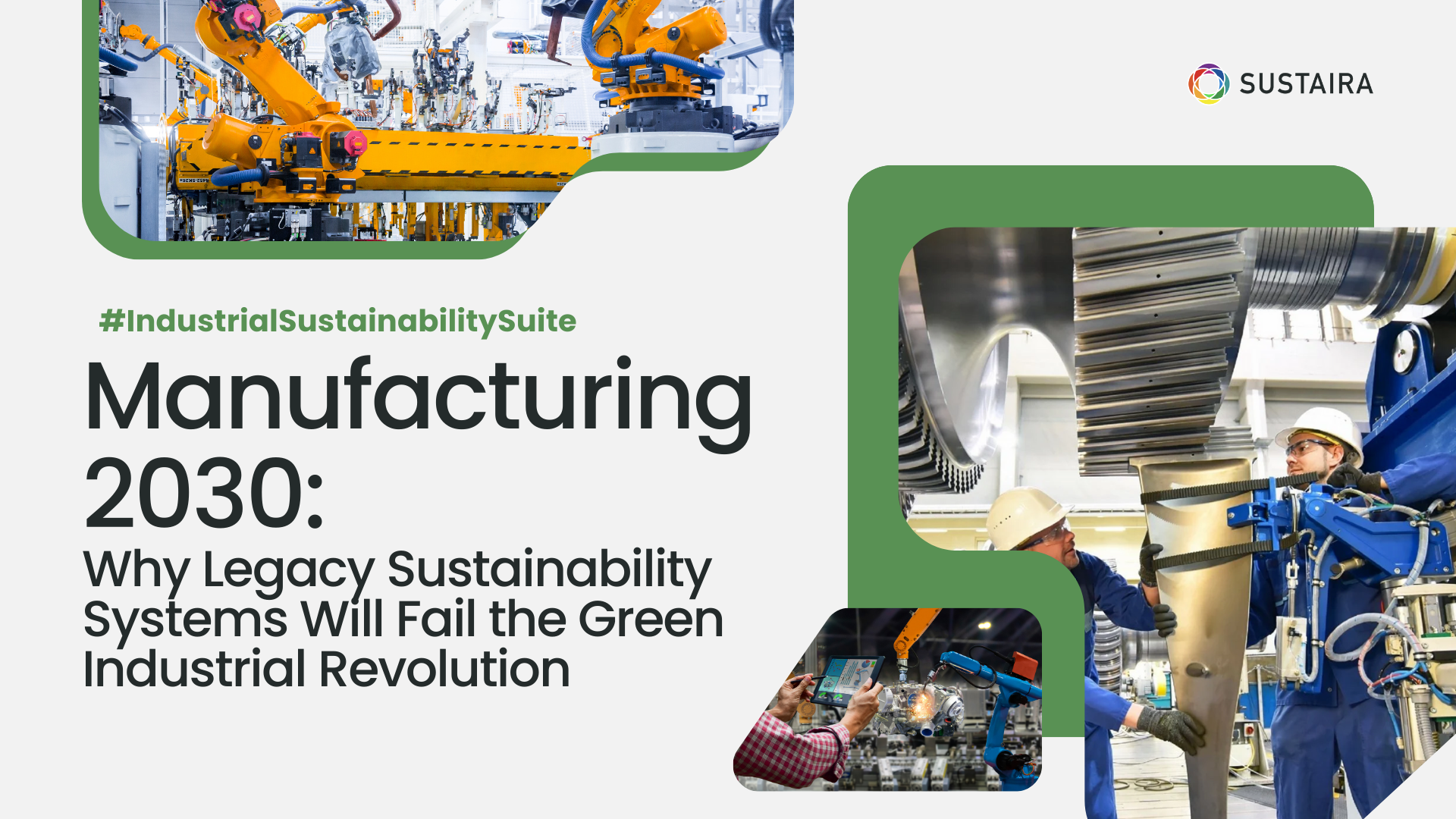
The manufacturing sector is no stranger to revolution. From steam engines to assembly lines and the digital shift of Industry 4.0, the industry has spent two centuries perfecting the art of efficiency. However, as we look toward 2030, a new paradigm is emerging. This isn't just another incremental update; it is a Green Industrial Revolution.
For today’s sustainability leaders, the challenge has shifted. Sustainability is no longer a peripheral regulatory project; it is becoming a core operational pillar embedded in everyday decisions. The organizations that will lead the next decade are those that treat decarbonization not as a cost center, but as the ultimate driver of innovation and resilience.
The End of the "Efficiency at All Costs" Era
Historically, manufacturing excellence was measured by throughput and cost-per-unit. Today, a third variable has entered the equation: Carbon Intensity. Manufacturers are facing a "perfect storm" of pressures that make the green transition unavoidable:
Regulatory Cracking Down: New standards such as CSRD, CBAM, and the EUDR are forcing a level of data granularity that legacy systems cannot handle.
The Rise of "Green Steel" and Circularity: The transition to a circular economy is shifting how raw materials are processed and reused, particularly in heavy equipment and automotive sectors.
The Labor Shortage & the "S" in ESG: In both the US and Europe, a credible sustainability strategy has become a decisive factor for attracting engineers, operators, and future leaders who expect purpose-led organizations.
Efficiency alone is no longer enough. Transparency, accountability, and adaptability are now operational requirements.
Why Legacy Tools are Failing the Revolution
Many industrial firms are attempting to navigate this new era using tools from the last one. The result is friction, risk, and missed opportunities.
Manual Excel processes are error-prone, non-auditable, and fundamentally incapable of supporting real-time decision-making.
Rigid Point Solutions often create new data silos and carry high implementation costs, failing to provide the "single source of truth" executives need.
Custom-built systems struggle to keep pace with evolving regulations and quickly become costly to maintain, while one-size-fits-all platforms force organizations to pay for broad toolsets they don’t need, adding complexity instead of clarity.
This is the gap Sustaira was built to address.
The 2030 Blueprint: Modular, AI-Powered Industrial Intelligence
To thrive in 2030, manufacturers must move toward a pace-layered architecture, combining rigid systems of record with flexible "systems of innovation". Sustaira is where the convergence of Sustainability expertise, Modular low-code architecture, and AI-powered insights becomes transformative.
1. Unifying Fragmented Data Silos
Industrial sustainability data lives everywhere: ERPs, PLMs, energy meters, procurement systems, and external documents.
A modern sustainability platform acts as a Sustainability Integration Hub, connecting these fragmented sources into a single master data model for carbon accounting, ESG performance, and regulatory reporting.
This is where Sustaira is fundamentally different. Unlike most sustainability platforms that operate exclusively in shared SaaS environments, Sustaira is designed to support private cloud deployment, giving large manufacturers full control over data residency, access rights, and security architecture.
For organizations managing sensitive operational, supplier, and financial data, this ensures that sustainability intelligence can scale without compromising enterprise security or compliance requirements.
Instead of chasing data, sustainability teams gain a shared operational language across finance, operations, and procurement, built on infrastructure IT teams actually trust.
2. AI as an Operational Catalyst
Artificial Intelligence is the "engine" of this new revolution. It isn't just about chatbots; it's about:
Automated Data Mapping: Using AI to automatically categorize financial and operational data into relevant sustainability categories like energy usage or logistics.
Document Scraping: Leveraging OCR and NLP to extract emissions data directly from utility bills and invoices, reducing manual reporting workloads.
Predictive Insights: Moving from reporting what happened last year to forecasting carbon impacts and running scenario analysis for future energy efficiency measures.
This is the shift from static reporting to continuous, decision-grade sustainability intelligence.
The Path Forward
The path to 2030 is urgent and dynamic. For sustainability directors, the challenge is no longer about surviving the next audit, it’s about building an operating model that can thrive in a low-carbon economy.
This requires a shift in mindset: seeing sustainability data not as a burden, but as the most valuable asset in the factory of the future.
At Sustaira, we believe the Green Industrial Revolution will be led by manufacturers who invest early in the right data foundations.
The revolution is here. The only question is whether your infrastructure is ready to lead it.
Discover Sustaira’s Industrial Sustainability Suite
Sustaira’s Industrial Sustainability Suite is built for this new era. Designed for modular deployment and private cloud environments, it unifies fragmented data across ERPs, PLMs, energy meters, and procurement systems while maintaining enterprise-grade security and compliance. With AI-powered insights, automated data mapping, and predictive scenario analysis, sustainability teams can move beyond retroactive reporting and take proactive control of decarbonization strategies.
Discover how your organization can transform sustainability from a compliance requirement into a true driver of operational excellence and long-term growth.
