
Five Signs Your Sustainability Processes Are Holding Your Organization Back
Sustainability has moved from a voluntary initiative to a core operating requirement. Frameworks like CSRD, the EU Taxonomy, CDP, and SBTi now demand a level of rigor once reserved for financial reporting: structured data, traceable methodologies, and disclosures that can withstand external assurance.
Many organizations are still running that operation on processes built for a much smaller, much less regulated version of sustainability work. The gap between what's expected and how the work actually gets done is where teams quietly fall behind. Here are five signs that gap has already opened up in your organization.
1. Your sustainability data still lives in spreadsheets
If your emissions data, supplier information, and KPI tracking depend on someone maintaining a master spreadsheet, or several, stitched together before every reporting cycle, you don't have a sustainability program. You have a fragile manual process that happens to produce a report.
Spreadsheets don't scale with regulatory complexity. They have no built-in audit trail, no validation logic, and no way to trace a number in your final disclosure back to its original source without someone remembering how it got there. Every new framework, business unit, or data source adds another layer of manual reconciliation, and another point where errors creep in unnoticed.
2. Scope 3 is mostly a guess
Scope 3 typically makes up 70 to 90% of a company's total emissions, and it's the category most organizations still handle the least rigorously. If your Scope 3 numbers are built almost entirely on generic spend-based averages, with no path toward supplier-specific primary data, your footprint estimate is more of a placeholder than a measurement.
This matters beyond accuracy. Regulators, investors, and customers are starting to ask harder questions about methodology, not just totals. An organization that can't explain how its Scope 3 figure was calculated, or show a credible plan to improve it, is exposed the moment someone asks.
3. Reporting season is a fire drill
If disclosure season means weeks of chasing down data from different departments, reconciling conflicting numbers, and manually reformatting everything into the right template, your process isn't sustainable, literally or figuratively. This pattern usually means data collection, validation, and reporting are disconnected steps instead of a continuous, structured workflow.
The cost isn't just stress. Fire-drill reporting tends to produce reports that are technically complete but methodologically thin, because there's no time left to improve data quality once the scramble begins. Teams end up optimizing for "get it out the door" instead of "get it right."
4. Sustainability data doesn't inform any actual decisions
A lot of organizations can produce a report. Fewer can point to a specific decarbonization investment, supplier change, or operational decision that was directly shaped by their sustainability data. If your sustainability output is a PDF that gets filed and forgotten until next year, the data is doing compliance work, not business work.
This is usually a symptom of disconnected systems: emissions data sits in one place, financial and operational planning happens somewhere else, and nothing links them. Without that link, sustainability stays a reporting exercise instead of becoming a lever for actual risk reduction and cost savings.
5. Every new regulation means a rebuild
CSRD, ESRS updates, SEC climate rules, evolving state-level mandates: the regulatory landscape hasn't slowed down, and it isn't going to. If your team dreads every new requirement because it means another round of custom spreadsheet templates, another consultant engagement, or another months-long IT project, your infrastructure isn't built for how this space actually moves.
A sustainability process that can't absorb a new framework without a ground-up rebuild will always be reacting late, at the highest cost, under the most time pressure. That's an expensive and risky way to stay compliant.
What this adds up to
None of these five signs are really about effort. Most sustainability teams are already working hard, often too hard, to compensate for weak underlying processes. The real issue is infrastructure: whether your organization has a system built to handle sustainability data with the same rigor, traceability, and scalability as financial data, or whether it's relying on manual workarounds to get there each year.
Recognizing these signs is the easy part. The harder question is what a process built for where sustainability regulation and stakeholder expectations are actually headed should look like.
From diagnosis to a real plan
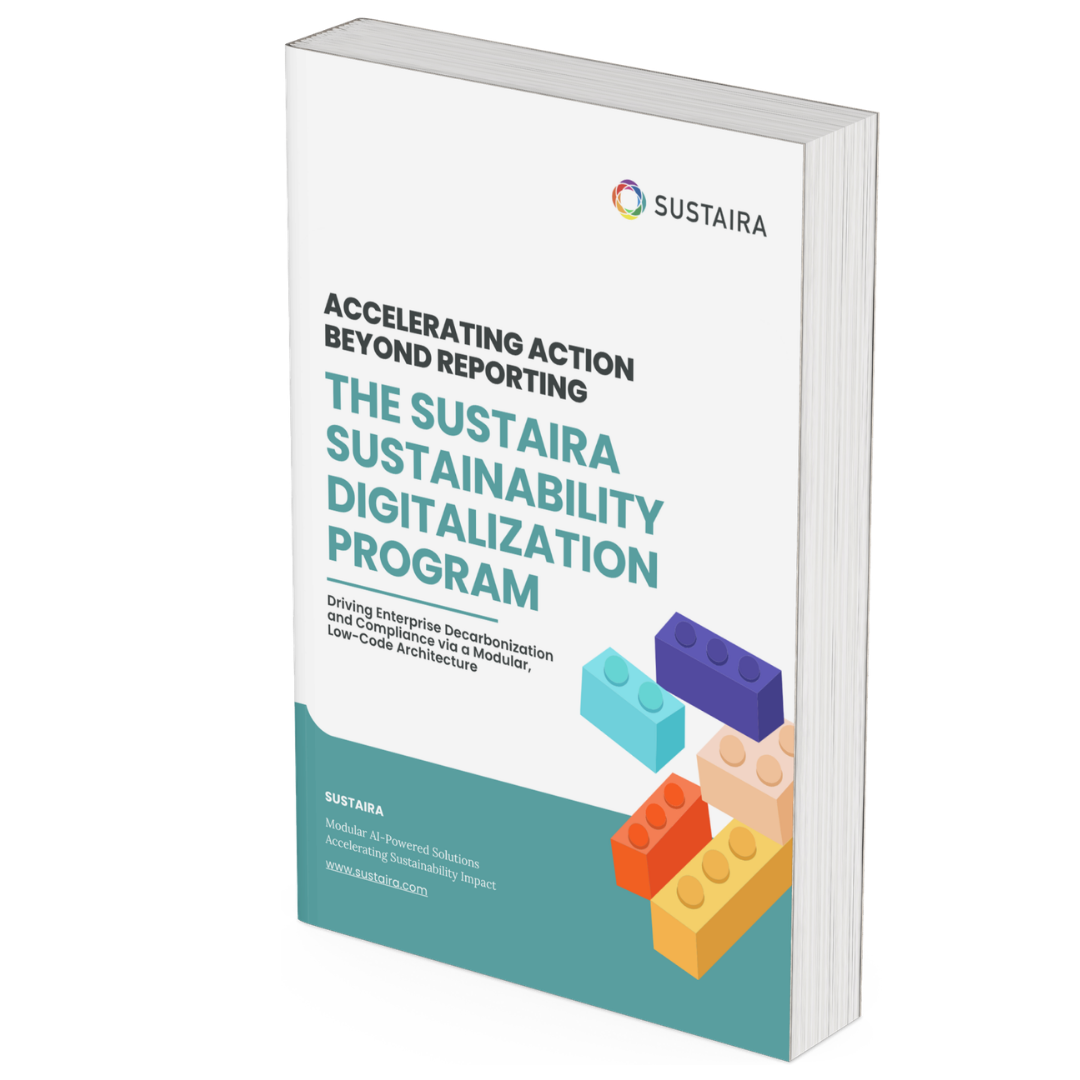
Spotting these signs is only useful if there's a clear path out of them. The Sustaira Sustainability Digitalization Program is built for exactly that transition. It replaces the all-or-nothing legacy overhaul with a phased approach, the 3S Framework, that takes an organization from Start (replacing manual tracking with a verified baseline) through Structure (standardized, automated reporting and governance) to Scale (sustainability intelligence embedded across Risk, Finance, Supply Chain, Operations, and HR).
Each phase is coordinated across five operational pillars, Portfolio, People, Process, Platform, and Promotion, so technology, team, and process evolve together instead of pulling in different directions. It's a concrete answer to the five signs above, not just a description of the problem.
Explore the Sustainability Digitalization Program to see how a phased rollout could work for your organization, or schedule a demo to talk through where you'd start.
