
Before You Buy Sustainability Software, Ask These 10 Questions
The sustainability software market has exploded. Whatever your need carbon accounting, ESG reporting, supply chain traceability, energy management, there are now dozens of vendors promising to solve it. That's good news for buyers in theory. In practice, it makes picking the right tool harder, not easier.
Most sustainability software purchases don't fail because the product was badly built. They fail because the buyer didn't ask the right questions up front, about data, methodology, scalability, or what happens after the contract is signed. A tool that looks great in a demo can become a liability a year later if it can't keep up with new regulations, new data sources, or a growing team.
Before you sign anything, work through these ten questions.
1. What frameworks and standards does it actually support?
"Supports ESG reporting" isn't a specification, it's a marketing line. Ask which specific frameworks are built in: GHG Protocol, CSRD/ESRS, TCFD, ISSB, SASB, CDP, SEC climate rules, or whichever apply to your business and markets. Ask how the vendor keeps pace when a standard changes. Regulatory frameworks evolve fast right now, and a platform that requires a custom build every time a standard updates will cost you time you don't have.
2. Where does the data actually come from, and how is it verified?
Every sustainability platform is only as credible as its inputs. Ask exactly how data gets into the system: manual upload, API integrations, IoT sensors, utility bill parsing, supplier surveys, and what happens when that data is incomplete, estimated, or self-reported. Look for clear documentation of emission factors, data sources, and assumptions. If a vendor can't explain where a number in a report came from, an auditor or regulator won't accept it either.
3. Can it handle Scope 3 emissions with real rigor, not just estimates?
Scope 3 is usually 70–90% of a company's carbon footprint, and it's also the hardest to measure. Many tools handle Scope 1 and 2 well and then fall back on generic spend-based estimates for Scope 3. Ask how granular the Scope 3 methodology gets, whether it supports supplier-specific primary data, and how the platform helps you improve data quality over time rather than settling for rough averages indefinitely.
4. Is the platform audit-ready?
As sustainability disclosures move from voluntary to mandatory in many jurisdictions, third-party assurance is becoming standard. Ask whether the software maintains a clear audit trail, version history, and documentation trail an external auditor could actually follow. If assurance-readiness is an afterthought in the product, it will become your problem at the worst possible time, right before a filing deadline.
5. How well does it integrate with the systems you already use?
Sustainability data lives in ERP systems, utility accounts, procurement platforms, HR systems, and spreadsheets scattered across departments. A tool that requires everyone to re-enter data manually will quietly fall out of use within two quarters. Ask about existing integrations, API access, and what it takes to connect systems that aren't on the pre-built list.
6. Does it scale with your reporting maturity, not just your headcount?
Your sustainability program today probably isn't where it'll be in three years. Ask how the platform supports you as requirements grow. From a single facility to multiple business units, from one framework to several, from internal tracking to public-facing disclosure. Some tools are excellent starter platforms but hit a ceiling quickly; others are enterprise-grade but overkill (and overpriced) for where you are now. Be honest about which stage you're actually at.
7. Who owns the data, and can you get it out?
Ask directly: if you switch vendors in three years, can you export your full historical dataset in a usable format? Some platforms make this easy; others make it deliberately painful. Data portability should be spelled out in the contract, not left to a support ticket later.
8. What does implementation actually require from your team?
Vendors quote onboarding timelines in the sales process, but ask specifically: how many hours will your team need to spend, who needs to be involved, and what does a realistic first 90 days look like? A "quick setup" that actually requires a dedicated project manager for two months is a hidden cost that belongs in your decision now, not a surprise later.
9. How is pricing structured, and what triggers a price increase?
Sustainability software pricing can scale with facilities, users, emissions sources, revenue, or report volume, sometimes several of these at once. Ask for a clear breakdown of what happens to the price as your program grows: adding a new business unit, a new region, a new framework, or more users. Get this in writing before you're locked into a multi-year contract.
10. What does support look like when a regulation changes?
Regulations like CSRD and the SEC's climate rules have already shifted timelines and requirements more than once, and more changes are likely. Ask how the vendor communicates and implements regulatory updates, proactively, as part of the subscription, or as a paid change request. A platform's real value shows up not on launch day, but the day the rules change and you need to adapt fast.
The bigger picture
None of these questions are about finding the vendor with the most features or the flashiest dashboard. They're about finding a platform that will still be trustworthy, auditable, and useful three years from now, when your reporting obligations are stricter, your data volume is bigger, and the stakes of getting it wrong are higher.
Take your time, ask vendors to answer these questions in writing, and be wary of anyone who can't. The right sustainability software should make your program more credible, not just more automated.
Want a deeper framework than 10 questions?
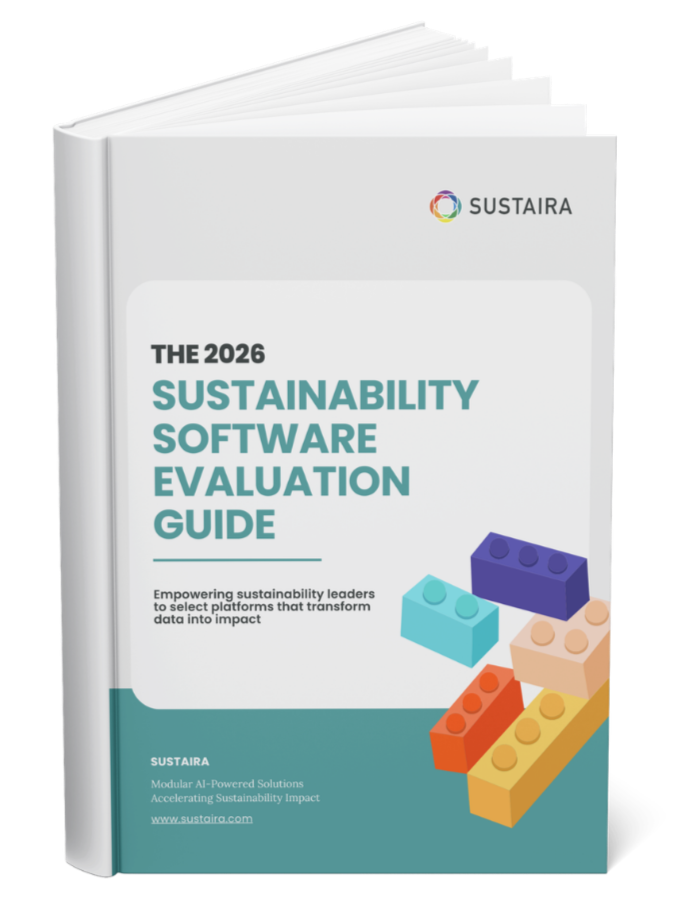
This list is a starting point. If you're running a formal RFP or comparing multiple vendors side by side, you'll want a more structured way to score them, that's exactly what we built the 2026 Sustainability Software Evaluation Guide for.
It expands on everything above with a full evaluation framework across three dimensions:
Functional criteria — core workflows, program management, data acquisition, actions and rewards, reporting, and customization flexibility
Technical criteria — data governance, access and architecture, internationalization, reusability, security and compliance, and AI capabilities
Organizational criteria — enablement, support model, and futureproofing
Each section comes with a side-by-side comparison table you can fill in as you evaluate vendors, plus five strategic questions sustainability leaders should be asking at every stage. It's the same rigor this article encourages, just with a scorecard attached.
Download the Sustainability Software Evaluation Guide to see how your shortlist stacks up or schedule a demo to see how Sustaira answers these questions firsthand.
